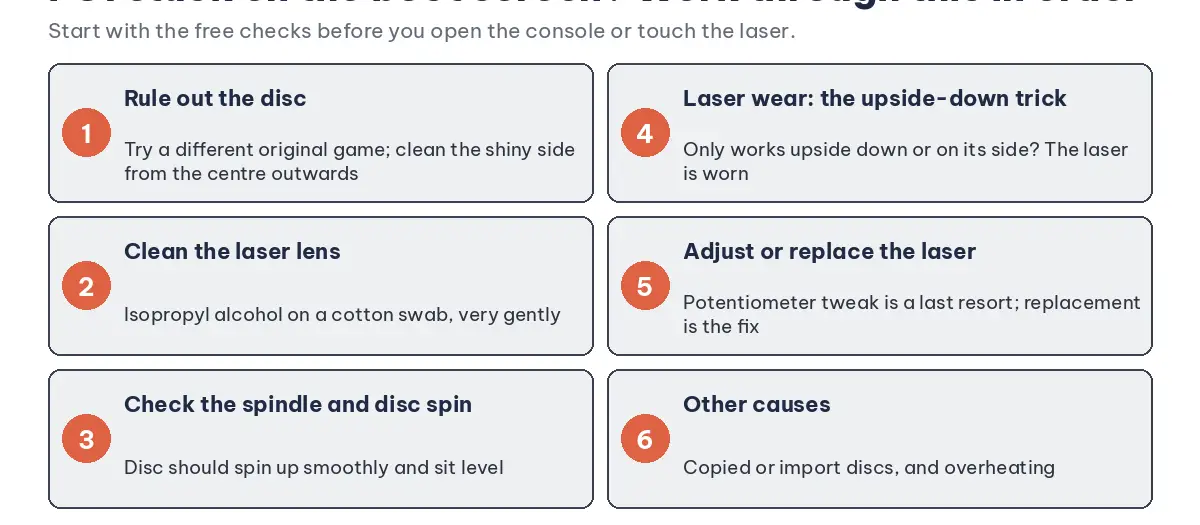
Quick answer: A PS1 stuck on the boot screen almost always has a disc-reading problem. Work through it in this order: 1) try a different, known-good original disc; 2) clean the disc; 3) clean the laser lens with isopropyl alcohol; 4) check the disc spins freely and the spindle grips it; 5) carefully adjust or replace the laser (KSM-440 series). Burned copies and imports will not boot on an unmodified console at all, so test with an original game from your region first.
You’ve dusted off your old PlayStation for a game of Metal Gear Solid, put the disc in and switched it on, and it sits on the boot screen and goes no further. The good news is that this is one of the most common PS1 faults, and it can usually be fixed at home.
Parts and supplies for fixing a PS1
- Replacement PS1 laser (KSM-440): the usual fix when cleaning doesn’t help. Check price on Amazon
- 99% isopropyl alcohol: for cleaning the lens with a cotton swab. Check price on Amazon
- Disc scratch repair kit: worth a try on a scratched game disc first. Check price on Amazon
Affiliate links: if you buy through them we may earn a small commission at no extra cost to you.
Which Boot Screen Is It Stuck On?
The PS1 shows two start-up screens. Noting which one it freezes on helps narrow the fault down.
- White “Sony Computer Entertainment” screen: the console has powered up and is trying to read the disc. If it hangs here, or the disc can be heard spinning up and down, suspect the disc, the lens or the laser.
- Black PlayStation logo screen: this only appears once the console has accepted the disc. If it stops here or goes black afterwards, try another game. A badly scratched area of the disc, or a laser that only just reads, can fail as loading begins.
- Goes to the memory card / CD player menu: the console has not detected a game disc. This is normal with the lid open, no disc or an audio CD, and it can also happen when the drive cannot read the game at all.
Step 1: Rule Out the Disc
It sounds obvious, but try another game first. If a different original disc boots, the first disc is the problem, not the console.
How to clean a PS1 disc
Wipe the shiny underside with a soft, lint-free cloth, working in straight lines from the centre out rather than in circles. Finger grease can be removed with a little water or isopropyl alcohol on the cloth. PlayStation discs are black on the data side, which makes scratches hard to see, so tilt the disc under a bright light.
How to fix a scratched PlayStation disc
Light scratches on the data side can often be improved with a CD scratch repair kit, or by having the disc professionally resurfaced. Resurfacing machines remove a very thin layer of polycarbonate with fine abrasives and then polish it. A badly resurfaced disc shows swirl marks. Damage on the label side is different: the data layer sits just under the label, so scratches there cannot be repaired.
Step 2: Clean the Laser Lens
Dust and smoke residue on the lens is the next most common cause. Unplug the console and open the lid. You will see the small round lens on the laser assembly. Moisten a cotton swab with isopropyl alcohol (99% is best), wipe the lens very gently with a light circular motion, and let it dry before testing. Don’t press hard, and don’t use window cleaner or other household cleaners. The lid sensor is the small switch the lid presses down on. If you are testing with the lid open, it has to be held down, or the drive won’t spin.
Step 3: Check the Spindle and Disc Spin
The spindle hub is the round platform the disc clips onto. If its clips are broken or worn, the disc slips as it spins and cannot be read. With the console unplugged, press a disc onto the hub. It should click into place and turn freely by hand without wobbling. If you power it on with the lid sensor held down and the disc doesn’t spin, spins very slowly, or the laser doesn’t move along its track, the drive motor or laser assembly is at fault. A broken hub can be replaced on its own, but it’s often simpler to fit a complete replacement drive assembly.
Step 4: Laser Wear and the “Works Upside Down” Trick
If your PS1 only boots when it is upside down or on its side, the laser assembly is almost certainly worn. The first PlayStations used a KSM-440AAM laser built entirely of plastic. Over time the plastic sled rail wears unevenly, and because the laser sits close to the hot power supply, it wears faster. Eventually the laser tilts and can no longer point straight at the disc. Turning the console over changes that angle. Sony later moved to a die-cast metal sled and placed the laser further from the power supply.
Other signs of a failing optical drive:
- The disc does not spin, or spins erratically
- Loud clicking or tracking noises
- The laser does not move along its track
- Skipping music or freezing FMV, and stalling on the boot screen
Adjusting the laser potentiometer (use caution)
The laser assembly has a tiny trimmer potentiometer that sets the laser’s output. On a weak laser, a small increase can sometimes restore reading. Do this only as a last resort before replacing the laser:
- Unplug the console and mark the pot’s current position with a fine pen.
- Turn it a few degrees at a time, then test with a known-good original disc.
- If there is no improvement after a few small steps, return it to the mark.
- Turning it up drives the laser harder, which can shorten its life, so treat this as a stop-gap.
Replacing the PS1 laser
If cleaning and adjustment do not help, fit a replacement laser. PS1 models use lasers from the KSM-440 family, and the exact suffix varies by model. The original SCPH-1000/1001 consoles used the KSM-440AAM. Check the code printed on your existing laser and your console’s SCPH model number before you order. On most models the swap is a screwdriver job: remove the bottom screws, lift the top shell, unplug the ribbon cable and remove the laser assembly. Alternatively, replace the whole optical drive with a used or refurbished unit. If you are buying a replacement console instead, our guide on checking a retro console works before buying covers what to test.
Other Causes: Copies, Imports and Heat
Burned discs and imports. Genuine PlayStation discs carry a deliberately irregular “wobble” signal that ordinary CD burners do not copy, and the same signal encodes the region. An unmodified console will not boot a disc without the correct one, so a CD-R or a game from another region simply will not start. That is expected behaviour, not a fault.
Overheating. Early PlayStations were known to overheat, which could warp the plastic disc mechanism slightly and cause read errors. If the console starts fine when cold but fails after it warms up, make sure the vents on the bottom are not blocked by carpet or a soft surface, and do not stack it on other hot equipment.
When It Is Time to Replace the Console
If a new laser, a good disc and clean contacts still leave it stuck, the fault is likely on the main board or the power supply, which is a harder repair. At that point, compare the cost with a replacement console using our PlayStation 1 price guide. Once yours is booting again, see our best PS1 to HDMI converters guide for a sharp picture on a modern TV, or our list of PS1 games that still hold up.
Frequently Asked Questions
Why is my PS1 stuck on the Sony logo?
If it stops on the white Sony Computer Entertainment screen, the console is usually failing to read the disc. The most common causes are a dirty or scratched disc, a dirty laser lens, or a worn laser that needs adjusting or replacing.
Why does my PlayStation only work upside down or on its side?
This classic symptom points to the laser assembly. On early PlayStations the plastic sled rail wears unevenly, so the laser tilts away from the disc. Turning the console over changes the angle enough for it to read. Cleaning may help briefly, but the lasting fix is usually a replacement KSM-440 laser.
Can a PS1 play burned discs or games from another region?
Not on an unmodified console. Genuine PlayStation discs carry a hidden authentication signal that also encodes the region, and a stock console will not boot a disc without the right one. A burned copy or an import on a stock console will not start, however good the drive is.
Is it safe to adjust the PS1 laser potentiometer?
It can revive a weak laser, but it is a last-ditch fix. Mark the starting position, turn it only a few degrees at a time, and test between moves. Turning it up drives the laser harder, which can shorten its life, so do not crank it.
How much does it cost to fix a PS1 that won’t read discs?
Cleaning costs almost nothing. If the laser has to be replaced, you need a KSM-440 series unit that matches your model, and prices vary, so check current listings. A replacement laser is usually far cheaper than another console.