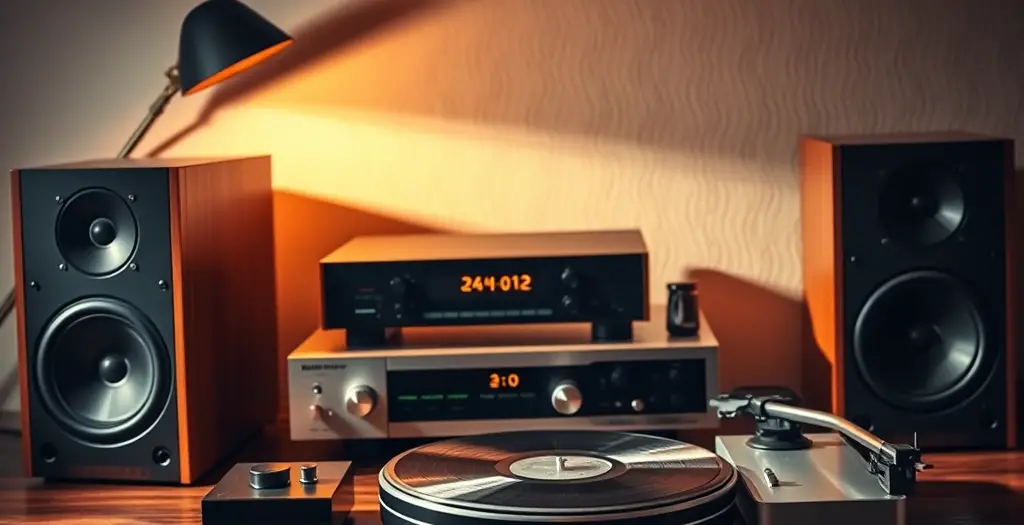
Quick Answer: For most people building their first vintage HiFi system, you need four core components:
- An integrated amplifier ($100–$400)
- A pair of bookshelf or floor-standing speakers ($80–$500)
- A turntable ($120–$500)
- Interconnect cables ($20–$80)
The sweet spot budget is $400–$800 total — and it can deliver sound quality that embarrasses modern systems costing three times as much.
The single best starting amplifier is a vintage Marantz or Pioneer unit from the late 1970s. Grab one on eBay for $150–$250, pair it with a set of bookshelf speakers, and you’re 80% of the way there.
After 25 years working in electronics engineering, I’ve built, repaired, and listened to more vintage HiFi systems than I can count.
What I keep coming back to is this: equipment made between 1965 and 1985 was engineered to last and engineered to sound extraordinary. The components were over-built, the tolerances were tight, and the designers actually cared.
This guide cuts through the noise and gives you a clear, practical path to assembling a vintage HiFi system that will make your jaw drop — without spending a fortune or getting burned by bad purchases.
Whether you’re starting from scratch or improving an existing setup, this is the guide I wish I’d had 25 years ago.
Comparison Table: Key Components at a Glance
| Component | Price Range (USD) | Best For | Key Feature | Where to Buy |
|---|---|---|---|---|
| Vintage Integrated Amp | $100–$400 | Most setups | All-in-one simplicity | Amazon |
| Vintage Receiver | $80–$350 | Budget builders | Amp + tuner combo | Amazon |
| Bookshelf Speakers | $80–$400 | Smaller rooms | Compact, detailed | Amazon |
| Floor-Standing Speakers | $200–$800 | Larger rooms | Full bass extension | Amazon |
| Belt Drive Turntable | $120–$500 | Vinyl playback | Smooth, quiet operation | Amazon |
| Phono Preamp | $30–$150 | Turntable users | RIAA equalisation | Amazon |
| RCA Interconnect Cables | $20–$80 | All setups | Signal routing | Amazon |
| Speaker Wire | $15–$60 | All setups | Connecting amp to speakers | Amazon |
| Multimeter | $25–$80 | DIY testing & repair | Voltage and impedance testing | Amazon |
Budget Tiers: Build Your System at Any Price Point
🟢 BUDGET TIER ($310–$525 total)
Best for: First-time buyers, students, casual listeners
| Item | Product | Price |
|---|---|---|
| Amplifier | Pioneer SX-series vintage receiver | $80–$150 |
| Speakers | Bookshelf speakers, 8-ohm, 50–80W rated | $80–$150 |
| Turntable | Audio-Technica AT-LP120 | $120–$180 |
| Cables | Basic RCA interconnect cables | $15–$25 |
| Speaker Wire | 14-gauge speaker wire 50ft | $15–$20 |
| TOTAL | ~$310–$525 |
At this tier, you’re getting real HiFi. A working vintage Pioneer receiver can push 40–60 watts per channel of genuinely musical power.
Paired with decent bookshelf speakers in an average-sized room, this will sound better than any soundbar or Bluetooth speaker at any price.
🔵 MID TIER ($600–$1,130 total)
Best for: Serious listeners who want genuinely excellent sound
| Item | Product | Price |
|---|---|---|
| Amplifier | Vintage Marantz or Sansui integrated amp | $180–$350 |
| Speakers | Bookshelf or compact floor-standers, 87dB+ | $150–$300 |
| Turntable | Mid-range belt drive with built-in phono stage | $180–$300 |
| Cables | Quality RCA interconnects (Mogami or similar) | $30–$60 |
| Speaker Wire | 12-gauge oxygen-free speaker wire | $25–$40 |
| Phono Preamp | If amp lacks phono stage | $35–$80 |
| TOTAL | ~$600–$1,130 |
This is where vintage HiFi starts to genuinely compete with modern high-end equipment at multiples of the price.
A good Marantz receiver from the 1970s driving efficient bookshelf speakers produces the kind of soundstage and tonal richness that modern Class D amplifiers simply struggle to match.
🟡 PREMIUM TIER ($1,390–$2,800 total)
Best for: Audiophiles who want reference-quality vintage sound
| Item | Product | Price |
|---|---|---|
| Amplifier | Marantz 2270 / Sansui G-9000 / Pioneer SX-1980 | $400–$800 |
| Speakers | Floor-standers, high-efficiency (90dB+) | $300–$700 |
| Turntable | Rega Planar or Pro-Ject Debut | $400–$700 |
| Phono Preamp | Graham Slee or similar standalone unit | $150–$300 |
| Interconnects | High-quality RCA cables throughout | $60–$120 |
| Speaker Cable | Premium 12-gauge, bi-wire capable | $50–$100 |
| Record Care | Vinyl record cleaning kit | $30–$80 |
| TOTAL | ~$1,390–$2,800 |
At this level you’re building a system that audiophiles pay $10,000+ to replicate with new equipment.
A fully recapped Marantz 2270 driving efficient floor-standers is a transcendent listening experience.
Section 1: Understanding the Core Components
The Amplifier — The Heart of Your System
The amplifier takes the low-level signal from your source — turntable, CD player, or streamer — and amplifies it to a level capable of driving your speakers.
In vintage HiFi, you’ll encounter three main configurations:
| Type | What It Is | Best For |
|---|---|---|
| Integrated Amp | Preamp + power amp in one box | Most setups — simple, practical |
| Receiver | Integrated amp + AM/FM tuner | Budget buyers and radio listeners |
| Separate Pre/Power | Two separate components | Audiophiles wanting ultimate quality |
Brands to look for:
| Brand | Sound Character | Best Models |
|---|---|---|
| Marantz | Liquid, musical | 22xx receivers, PM integrated amps |
| Pioneer | Dynamic, punchy | SX-series receivers |
| Sansui | Warm, detailed | AU and G-series |
| Yamaha | Precise, slightly cool | A- and CR-series |
| Kenwood | Neutral, reliable | KA and KR series |
What to look for when buying:
- Power output: 40–80 watts per channel is plenty for most rooms. Don’t chase wattage — a well-designed 30W amp beats a poorly designed 100W unit every time.
- Impedance rating: Must match your speakers (4-ohm, 6-ohm, or 8-ohm). Mismatching causes overheating and failure.
- Condition: Prioritise serviced or recapped units. Electrolytic capacitors degrade over decades. A capacitor replacement kit and basic soldering skill can transform a tired amp.
- Inputs: Check you have enough — Phono, Tape, Aux/CD, and Tuner are the standard four.
Speakers — Where the Magic Happens
No component matters more than your speakers. An average amplifier driving excellent speakers will always sound better than an excellent amplifier driving average speakers. Weight your budget here.
Key specs to understand:
| Spec | What It Means | What to Look For |
|---|---|---|
| Impedance | Electrical load on the amp | Must match amp rating (usually 8Ω) |
| Sensitivity | How loud per watt input | 88dB+ for vintage amps |
| Power handling | Max wattage before damage | Should exceed amp’s rated output |
| Frequency response | Bass and treble range | Wider is generally better |
Bookshelf vs. Floor-Standing — which is right for you?
- Bookshelf speakers — easier to position, work near walls, great in small-to-medium rooms. Bookshelf speakers in the $150–$400 range offer outstanding value.
- Floor-standers — more bass extension, better for larger rooms, higher output. Floor-standing speakers at $300–$600 are tremendous value in 2026.
Free performance upgrade — speaker placement:
- Pull speakers at least 30cm (12 inches) from rear walls
- Position them at ear height when seated
- Toe them inward toward your listening position
- Space them 2–3 metres apart
This costs nothing and can outperform a $200 component upgrade.
The Turntable — Your Vinyl Source
A turntable converts the mechanical groove in a vinyl record into an electrical signal. Setup quality matters as much as build quality — a well-adjusted $200 deck will outperform a poorly set-up $800 one.
Belt drive vs. Direct drive — which do you need?
| Type | How It Works | Best For |
|---|---|---|
| Belt drive | Motor isolated by elastic belt — quieter | Home listening |
| Direct drive | Motor coupled directly to platter | DJing and cueing |
For home listening, belt drive is the right choice every time.
The phono stage — don’t skip this:
Turntables produce a very low signal (~2–5mV) that needs amplification and RIAA equalisation before it hits your amp. Check for a “Phono” input on your amplifier’s rear panel — if it’s there, you’re covered. If not, you need a standalone phono preamp ($30–$150).
Turntable setup checklist:
- Cartridge correctly seated in headshell
- Tracking force set with a stylus force gauge (most MM carts: 1.8–2.2g)
- Anti-skate set to match tracking force
- Ground wire connected to amplifier
- Stylus checked for wear — replace if needed (replacement styli here)
Cables — Don’t Overthink It, But Don’t Ignore It
The audiophile world is full of wildly expensive cables with dubious claims. The engineering reality: cables matter up to a point, then returns diminish rapidly.
Cable buying guide:
| Cable Type | What to Spend | What to Buy |
|---|---|---|
| RCA Interconnects | $20–$60 | Shielded RCA cables — shielding quality matters most |
| Speaker Wire (under 5m) | $15–$30 | 14-gauge OFC speaker wire |
| Speaker Wire (over 10m) | $25–$50 | 12-gauge OFC speaker wire — lower resistance |
| Terminations | $15–$30 | Banana plug connectors — tidier, more reliable |
The bottom line: spend your cable budget on shielding quality, not exotic materials. Redirect any remaining budget to better components or speaker positioning — those make a far more audible difference.
Section 2: How to Set Up Your Vintage HiFi System
Time required: 60–90 minutes
What you need:
- Vintage integrated amplifier or receiver ($100–$400)
- Bookshelf or floor-standing speakers ($100–$400)
- Belt drive turntable with cartridge ($120–$300)
- RCA interconnect cables ($20–$60)
- 14-gauge speaker wire ($15–$25)
- Phono preamp if amp has no Phono input ($30–$80)
- Stylus force gauge ($15–$30)
- Multimeter ($25–$60)
Step-by-Step Setup
Step 1 — Position your speakers
Place them 2–3 metres apart at ear height when seated, at least 30cm from rear walls. Toe them inward toward your listening position.
Speaker placement has a bigger effect on sound than almost any component upgrade. Don’t rush this step.
Step 2 — Position the amplifier
Place it on a stable surface with adequate ventilation on all sides. Vintage amplifiers generate real heat — never enclose them in a tight cabinet.
A HiFi equipment rack ($40–$150) keeps everything organised and well-ventilated.
Step 3 — Run the speaker wire
- Measure the distance from each speaker to the amp, add 20% for routing
- Strip 10–15mm of insulation from each end
- Fit banana plug connectors if using them
- Connect: red = positive, black = negative on both amp and speaker
- ⚠️ Reversed polarity on one speaker causes bass cancellation and poor stereo imaging
Step 4 — Set the impedance selector
Set the amp’s impedance switch to match your speakers (4Ω or 8Ω). If there’s no selector, check the manual before connecting 4-ohm speakers.
Step 5 — Check for a phono input
Look for a “Phono” or “Phono/MM” label on the amp’s rear panel.
- If it’s there — connect the turntable directly to the Phono input
- If not — connect a standalone phono preamp between turntable and an Aux input
Step 6 — Connect the turntable
- Run the turntable’s RCA leads to the Phono input (or phono preamp)
- Connect the turntable’s ground wire to the amp’s ground terminal — this eliminates hum
- No ground terminal? Connect to any chassis screw on the amplifier
Step 7 — Set tracking force
- Balance the tonearm so it floats horizontally
- Dial in tracking force using your cartridge’s specified range
- Verify with a digital stylus force gauge
- Most MM cartridges: 1.8–2.2 grams
Step 8 — Set anti-skate
Match anti-skate to your tracking force setting (e.g., 2g anti-skate for 2g tracking force). This keeps the stylus tracking evenly across the record.
Step 9 — Power on correctly
Always follow this order:
✅ Turning on: Sources first → Amplifier last ✅ Turning off: Amplifier first → Sources last
This prevents the loud thumps that can damage tweeters.
Step 10 — Check channel balance
Play a mono record or signal. Both channels should be equally loud with a centred image. If one side is quieter, check connections and the amplifier’s balance control.
Step 11 — Fine-tune speaker position
Play a familiar recording with strong stereo imaging — vocals or acoustic guitar work well. Move speakers in 2–5cm increments. You’re aiming for a stable, centred stereo image with instruments in distinct positions.
Result: A fully functional vintage HiFi system delivering genuinely high-fidelity sound.
Section 3: Speaker Impedance and Amplifier Matching Explained
This is the most technically misunderstood topic in vintage HiFi — and getting it wrong can damage equipment.
What is impedance?
Impedance is the AC equivalent of resistance — the opposition a speaker presents to current from the amplifier. It’s measured in ohms (Ω) and varies with frequency. A speaker rated at “8 ohms” might dip to 4 ohms at certain frequencies.
Why does it matter?
When you connect a lower-impedance speaker than the amp is designed for:
- More current is drawn from the output stage
- The amp runs hotter
- In the worst case, output transistors fail
This is a genuine risk with vintage equipment — many 1970s amps were designed exclusively for 8-ohm loads.
Quick impedance reference:
| Speaker Rating | DC Resistance Reading | Compatible With |
|---|---|---|
| 8Ω nominal | 5.5–7Ω DC | Most vintage amps |
| 6Ω nominal | 4–5.5Ω DC | Check amp spec sheet |
| 4Ω nominal | 3–4Ω DC | Only amps rated 4–8Ω |
Use a multimeter to check your speaker’s DC resistance before connecting.
Power matching — what actually matters:
| Scenario | Risk Level | Notes |
|---|---|---|
| 100W amp, 50W speakers at low volume | ✅ Low | You’re never near the limit |
| 30W amp, 100W speakers | ✅ Low | Speakers just play at lower volume |
| Underpowered amp driven into clipping | ⚠️ High | Clipping produces square waves that destroy tweeters |
Vintage vs modern power ratings:
Vintage amplifier power ratings (watts RMS) were measured honestly under defined test conditions. A 40W RMS Marantz really does produce 40 watts of clean power.
Modern receivers often quote “music power” or peak figures — marketing numbers. Be sceptical.
Section 4: Connecting a Modern Streaming Source
Vintage HiFi and modern streaming work brilliantly together. All three options below connect to a standard Aux input on your amplifier via RCA cables.
| Option | Cost | Quality | Best For |
|---|---|---|---|
| Bluetooth Receiver | $20–$50 | Good | Casual streaming, simplest setup |
| Network Streamer (WiiM etc.) | $80–$300 | Excellent | Audiophile-grade wireless streaming |
| USB DAC + Laptop/Phone | $35–$150 | Excellent | Bit-perfect playback from any device |
Hearing hum when you connect modern electronics?
A ground loop isolator ($10–$25) on the RCA connection breaks the loop causing the interference. It’s the first thing to try — and it almost always works.
Section 5: Troubleshooting Common Vintage HiFi Problems
Quick Fault Finder
| Symptom | Most Likely Cause | First Fix |
|---|---|---|
| Constant hum from turntable | Ground wire not connected | Connect ground wire to amp terminal |
| Hum on all inputs | Failing power supply capacitors | Recap the amplifier |
| Hum from multiple sources | Ground loop | Ground loop isolator ($10–$20) |
| One channel dead or weak | Oxidised selector contacts | Spray with contact cleaner |
| Scratchy volume control | Oxidised pot contacts | DeoxIT D5 into pot while turning |
| Distorted sound at low volume | Bias or capacitor issue | Service the amplifier |
| No bass / thin sound | Reversed polarity on one speaker | Swap +/- on one speaker terminal |
Hum and Buzz — In Detail
Hum comes in two types:
- 50/60Hz mains hum — a deep, steady drone. Usually ground-related.
- 100/120Hz buzz — a harsher, more complex sound. Often failing capacitors.
Fix sequence — work through this in order:
- Connect the turntable ground wire — fixes the majority of cases immediately
- If hum persists, add a ground loop isolator to the RCA connection
- If hum varies with the volume control, the problem is inside the amp — likely capacitors
- A mains power conditioner ($40–$150) cleans the mains supply and eliminates supply-related hum
- A capacitor replacement kit and an hour of soldering permanently fixes capacitor-related hum
One Channel Dead or Weak
Before assuming a failed transistor, clean the controls first:
- Spray DeoxIT contact cleaner into the input selector and volume pot
- Rotate them fully through their range several times while spraying
- This fixes the majority of intermittent channel problems — and takes five minutes
Scratchy Volume Control
Classic symptom of oxidised potentiometer contacts.
Spray DeoxIT D5 ($10–$20) into the pot while turning it. Repeat several times. The scratching typically disappears within minutes.
7 Mistakes to Avoid When Building a Vintage HiFi System
Mistake 1: Buying unchecked vintage equipment
| Problem | Failed capacitors, burnt resistors, and bad joints are invisible until powered up |
| Solution | Buy from sellers who test and describe the unit. Ask if it’s been recapped or serviced |
| Fix | Budget for a capacitor kit ($30–$80) if buying blind |
Mistake 2: Ignoring speaker impedance
| Problem | 4-ohm speakers on an 8-ohm amp stresses output stages and causes failure |
| Solution | Always check both the amp’s rated load and the speaker’s rated impedance |
| Fix | Use a multimeter ($25–$60) to measure speaker DC resistance if unsure |
Mistake 3: Skipping the phono ground wire
| Problem | Without a ground connection, turntables produce loud 50/60Hz hum |
| Solution | Always connect the turntable’s ground wire to the amp’s ground terminal |
| Fix | If hum persists, a ground loop isolator ($10–$20) almost always resolves it |
Mistake 4: Not setting turntable tracking force correctly
| Problem | Too light = mistracking and skipping. Too heavy = accelerated record and stylus wear |
| Solution | Use a digital stylus force gauge ($15–$35), not the tonearm’s built-in scale |
| Fix | Set to midpoint of cartridge’s specified range. Most MM carts: 1.8–2.2 grams |
Mistake 5: Placing speakers against the back wall
| Problem | Wall proximity causes boomy, one-note bass and kills stereo imaging |
| Solution | Pull speakers at least 30cm from rear walls — more is better |
| Fix | Free — just move them and listen |
Mistake 6: Powering the amp on before sources
| Problem | Cold transistors in vintage amps produce turn-on thumps that damage tweeters |
| Solution | Sources on first, amp on last. Amp off first, sources off last |
| Fix | Add a speaker protection relay kit ($15–$40) to amps that lack built-in protection |
Mistake 7: Spending on expensive cables before the basics are right
| Problem | No cable fixes mismatched components, bad placement, or a miscalibrated turntable |
| Solution | Get the fundamentals right first — cables are the last upgrade, not the first |
| Fix | Redirect cable budget to a better phono preamp or cartridge — both make a far more audible difference |
Related Guides on RetroTechLab
- Best Vintage Amplifiers Under $300: Tested and Ranked
- Speaker Impedance Explained: Complete Guide for HiFi Beginners
- How to Recap a Vintage Amplifier: Step-by-Step Guide
- Best Budget Turntables 2026: From First Deck to Serious Listening
- Vintage vs Modern Amplifiers: Is Old Better Than New?
Frequently Asked Questions
Q: What’s the best vintage HiFi amplifier for beginners?
Pioneer SX-series receivers from the late 1970s (SX-550, SX-650, SX-780) are the ideal starting point — reliable, repairable, and widely available at sensible prices.
Marantz 22xx receivers are the audiophile choice but cost more. For integrated amps without a tuner, the Marantz PM and Sansui AU series are outstanding. A vintage stereo receiver in the $100–$200 range is the best-value entry point.
Q: Do I need to recap a vintage amplifier before using it?
Not necessarily before first use, but it’s worth doing if the amp is over 30 years old or shows any hum, distortion, or intermittent behaviour.
Electrolytic capacitors have a finite lifespan and most vintage amps are overdue for service. A capacitor replacement kit and a few hours of soldering is worthwhile. Not comfortable doing it yourself? Local audio repair shops typically charge $50–$150.
Q: What speaker impedance should I use with a vintage amplifier?
Most 1970s–1980s vintage amplifiers are rated for 8-ohm speakers. Use 8-ohm speakers unless the manual specifically states 4–8 ohm compatibility.
Measure speaker DC resistance with a multimeter: a genuine 8-ohm speaker reads 5.5–7Ω DC. Under 4Ω DC means it’s effectively a 4-ohm design — check the amp spec before connecting.
Q: Can I add Bluetooth to a vintage amplifier?
Yes — connect a Bluetooth audio receiver ($20–$50) to an Aux input. Stream wirelessly from your phone; the signal is amplified by your vintage amp and plays through your speakers. Simple, effective, and completely reversible.
Q: How much should I spend on cables?
- Speaker cable: 14-gauge OFC wire at $15–$30 for 50ft covers most setups under 5 metres
- Interconnects: $25–$60 on decent shielded RCA cables
Don’t spend more until you’ve optimised components and speaker placement — those yield far greater returns.
Q: My turntable hums loudly. What’s wrong?
Almost certainly the ground wire. Connect it to the amp’s phono ground terminal first.
Still humming? Try a different ground point on the chassis. If hum persists across all inputs, suspect power supply capacitors in the amplifier. A ground loop isolator ($10–$20) resolves most remaining cases.
Q: Is a $200 modern turntable better than a vintage one?
The Audio-Technica AT-LP120 ($120–$180) is a reliable, ready-to-use deck with built-in phono stage and good cartridge — the ideal first purchase.
A vintage Thorens or Technics in good condition can outperform it, but requires more care in sourcing and may need servicing. Start with the AT-LP120 and upgrade to vintage later with more knowledge behind you.
Q: How do I check if a vintage amp’s output transistors are healthy?
Power the amplifier on with no speakers connected. Use a multimeter to measure DC voltage at the speaker terminals:
- Under 20mV DC — excellent
- Under 50mV DC — acceptable
- Over 100mV DC — needs attention before connecting speakers
Q: Can I connect a CD player or streaming device to a vintage system?
Absolutely. Any CD player with RCA outputs connects directly to an Aux or CD input. For streaming:
- Bluetooth receiver — $20–$40, instant setup
- Network streamer (WiiM Mini etc.) — $80–$150, audiophile-grade quality
The analogue RCA connection is universal and timeless — vintage amplifiers are fully compatible with any modern source.
Final Thoughts: Why Vintage HiFi Is Worth It
After 25 years in electronics, here’s my honest take: the best vintage HiFi equipment from the 1970s and early 1980s represents extraordinary engineering that is genuinely difficult to replicate at equivalent modern prices.
The over-built transformers, discrete transistor circuits, and hand-matched components produced amplifiers that have lasted half a century and still perform superbly.
The keys to success:
- Buy smart — always ask about service history before purchasing
- Set up correctly — most “bad sound” is actually a setup problem
- Weight your budget toward speakers and amplifier, not cables
- Be patient with positioning — it makes a dramatic difference
Build your system in this order:
- Amplifier and speakers first
- Turntable second
- Streaming source third
- Cable upgrades last
The vintage HiFi community is active, knowledgeable, and generous with advice. Whether you’re chasing the perfect soundstage or simply want music that sounds alive in your room, vintage HiFi is the most rewarding and cost-effective route available.
There has never been a better time to get started.