Quick Answer
Based on PriceCharting sold-listing averages checked on 26 October 2026 (US dollars, loose working consoles): an original Game Boy averages about $77 (PAL version about $56), a Game Boy Pocket about $55 to $100 depending on colour, a standard-colour Game Boy Color about $70 to $93, an original Game Boy Advance about $42 to $80, a Game Boy Advance SP AGS-001 about $89 to $125, the brighter AGS-101 SP about $142 to $166, a Game Boy Micro about $180 to $225, and the Japan-only Game Boy Light from about $130. Complete-in-box examples often sell for two to four times the loose price, and special editions sell for much more. Working condition matters most: a damaged screen, corrosion or faults lower the price considerably. Check recent eBay sold listings for your exact model and colour before you sell, and budget for a cleaning kit, a replacement screen or a replacement shell if yours needs one (check current prices).
Affiliate disclosure: RetroTech Lab earns a commission from qualifying Amazon purchases made through links on this page, at no extra cost to you. Prices quoted above come from PriceCharting, not Amazon.
Game Boy Price by Model (Complete Table)
Figures are PriceCharting market values in US dollars, which are averages of recent completed sales (mostly eBay sold listings), checked on 26 October 2026. “Loose” means console only; “CIB” means complete in box. Prices change daily, and UK sale prices in pounds will differ, so check eBay UK sold listings for your exact model and colour before you buy or sell.
| Model (US version) | Loose price | CIB price | PAL (UK/EU) loose examples |
|---|---|---|---|
| Original Game Boy DMG-01 (1989) | $77.47 | $201.25 | $56.16 |
| Game Boy Pocket (1996), by colour | $54.77 (Blue) to $99.99 (Ice Blue) | $98.82 to $400.00 | $63.02 (Silver), $77.07 (Green) |
| Game Boy Light (1998, Japan only) | $130.00 (standard listing) | $275.59 | Not sold in PAL regions |
| Game Boy Color (1998), standard colours | $69.50 (Atomic Purple) to $92.75 (Kiwi) | $187.00 to $226.52 | $64.38 (Lime Green) to $90.15 (Berry) |
| Game Boy Color Pokemon Special Edition | $154.98 | $1,120.26 | $101.67 |
| Game Boy Advance (2001), by colour | $42.31 (Platinum) to $80.00 (Glacier) | $98.68 to $173.80 | $30.46 (Black), $126.04 (Platinum) |
| Game Boy Advance SP AGS-001 (2003) | $88.59 (Platinum) to $124.66 (Pearl Blue) | $199.98 to $299.99 | $59.74 (Silver) |
| Game Boy Advance SP AGS-101 (2005) | $142.20 (Pearl Pink) to $165.80 (Pearl Blue) | $223.85 to $299.99 | Check sold listings |
| Game Boy Micro (2005) | $180.09 (Black) to $224.99 (Silver) | $299.99 to $543.91 | $108.42 (Blue), $203.15 (Green) |
Source: PriceCharting console pages for each model and colour, checked 26 October 2026. PAL figures come from fewer sales, so they move around more. Rare limited editions are not included in the ranges above.
How to Identify Your Game Boy Model
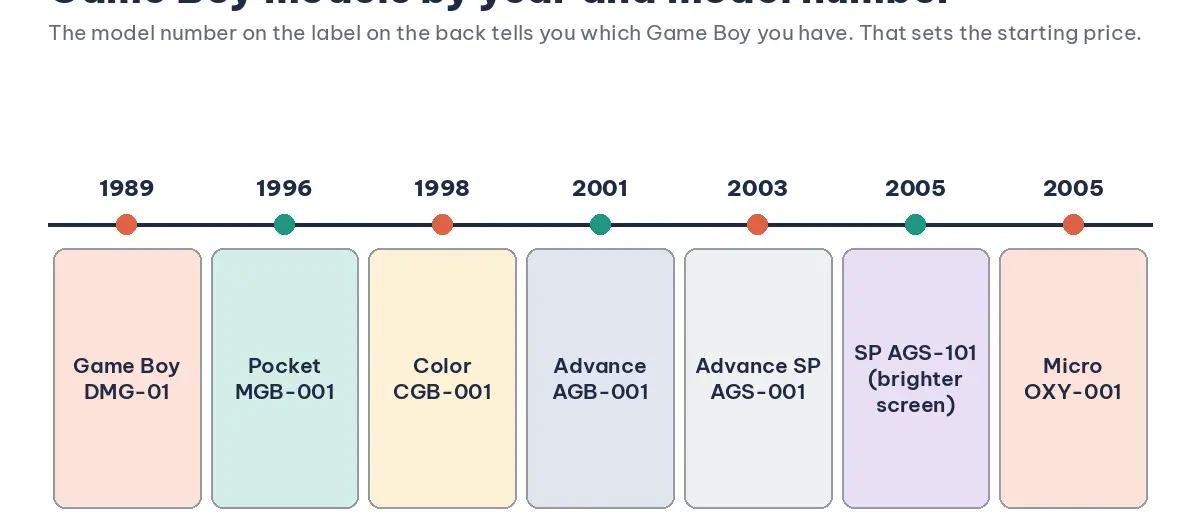
Before you can value a Game Boy, you need to know exactly which model you have. Every unit has a model number on the label on the back. That number tells you more than the shape does.
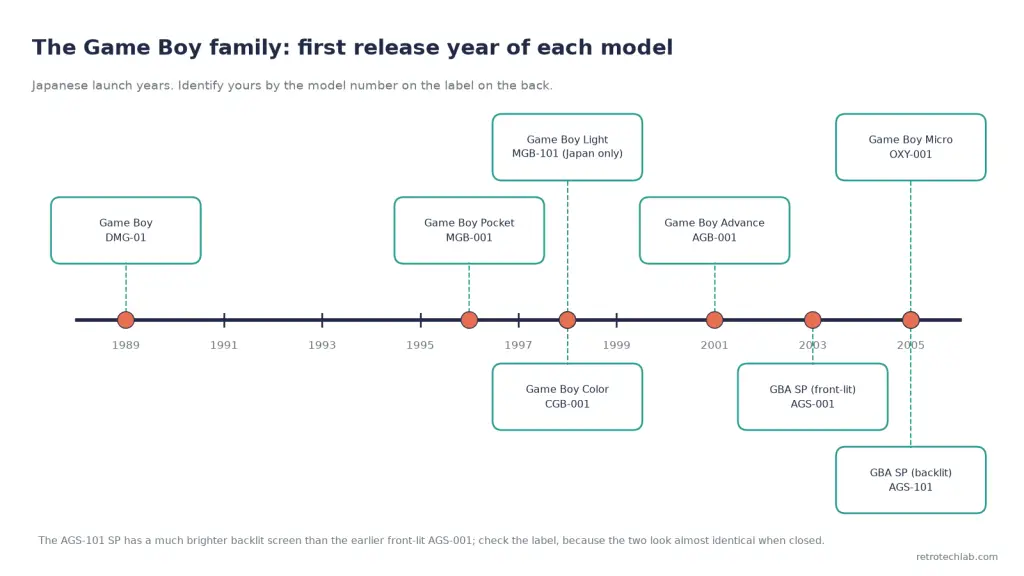
| Model | Model number | Released | How to recognise it |
|---|---|---|---|
| Game Boy (original) | DMG-01 | 1989 | Large grey brick with a green-tinted screen; takes 4 AA batteries |
| Game Boy Pocket | MGB-001 | 1996 | Smaller, thinner, takes 2 AAA batteries; black-and-white screen |
| Game Boy Light | MGB-101 | 1998 (Japan only) | Looks like a Pocket, with a backlight switch |
| Game Boy Color | CGB-001 | 1998 | Portrait shape with a colour screen; takes 2 AA batteries |
| Game Boy Advance | AGB-001 | 2001 | Landscape shape, wide screen, no light |
| Game Boy Advance SP | AGS-001 | 2003 | Clamshell with a front-lit screen and rechargeable battery |
| Game Boy Advance SP (backlit) | AGS-101 | 2005 | Same clamshell, but with a much brighter backlit screen |
| Game Boy Micro | OXY-001 | 2005 | Very small; plays GBA games only |
AGS-001 vs AGS-101: why the label matters
The two GBA SP versions look almost identical, but the AGS-101 has a backlit screen that is far brighter and clearer than the AGS-001’s front light. That makes it the more sought-after version among players. To check which you have:
- Read the label: it says MODEL NO. AGS-001 or AGS-101.
- Switch the light on: an AGS-101 has a light button that toggles between two brightness levels, and its blacks look properly black. An AGS-001’s front light gives a washed-out, slightly grey picture.
For values, see our Game Boy Advance SP value guide.
Are Old Game Boys Worth Anything?
Yes. Even common, well-used Game Boys usually sell, because people want to play original cartridges on original hardware. What a particular unit is worth depends on a few things you can check at home:
- Does it work fully? Test the screen, every button, the speaker, the headphone jack and the cartridge slot. A console that powers on but has faults is worth far less.
- Screen condition. On the original DMG-01, missing vertical lines are a common fault, caused by the screen’s ribbon-cable connection. It’s repairable but affects value. Check for scratches on the screen lens too.
- Original or modified? Many Game Boys now have aftermarket IPS screens, new shells or rechargeable battery mods. Modded units appeal to players, while collectors usually want original parts. Be clear about mods when you sell.
- Battery compartment. Check for corrosion on the battery contacts. On a GBA SP, check the battery isn’t swollen.
- Box and paperwork. Boxed, complete consoles are worth noticeably more to collectors than loose ones.
The Game Boy Color valuation guide and Game Boy Advance value guide cover those models in more detail.
How to Spot a Fake or Reproduction
Reproduction parts and outright fakes are common, especially for the GBA SP and Game Boy Color:
- Shells: aftermarket shells often have slightly different colours, softer plastic, poorly fitting battery covers, or a missing or incorrect back label.
- Screen lenses: reproduction lenses can have misaligned logos or printing.
- Cartridges: reproduction games often have poor label printing and a missing or wrong code stamped on the label or board.
- Chargers: cheap SP chargers are fine for use, but they don’t count as “original accessories” for collectors.
If you’re unsure, compare the listing photos with a known original. Ask the seller for clear photos of the back label and battery compartment.
Understanding Game Boy Value
What Determines Price?
1. Model (most important). On PriceCharting’s 26 October 2026 figures, the Game Boy Micro, the AGS-101 Game Boy Advance SP and the Japan-only Game Boy Light sell for the most as loose consoles. The original Game Boy, Game Boy Pocket, Game Boy Color and original Game Boy Advance sit lower because so many were made. See the table above for the figures.
2. Condition (big impact). Use this rating scale when you compare your console with sold listings:
- Poor: broken, doesn’t work, major damage
- Fair: works sometimes, cosmetic damage
- Good: works well, normal wear
- Very Good: minimal wear, works perfectly
- Mint: never used, original packaging
Sold-price averages cover working consoles in typical used condition. Faulty or damaged units sell for less, and boxed examples in excellent condition sell for considerably more. The gap between a broken console and a boxed, mint one is large.
Complete Game Boy Valuation by Model
All figures below are PriceCharting averages of recent sold listings, in US dollars, checked on 26 October 2026.
Original Game Boy (1989)
- US loose: $77.47. US complete in box: $201.25.
- PAL loose: $56.16. PAL complete in box: $308.61.
- What affects price: the original box and manuals, a clean screen with no vertical-line faults, no battery corrosion, and included games.
- Seller tips: photograph the screen powered on, clean the shell first, and mention the model number (DMG-01) on the back label.
Game Boy Pocket (1996)
- US loose by colour: Blue $54.77, Red $55.00, Silver $56.00, Black $59.33, Green $59.99, Clear $69.99, Yellow $84.99, Ice Blue $99.99.
- US complete in box: from $98.82 (Blue) to $400.00 (Ice Blue).
- PAL loose: Silver $63.02, Green $77.07.
- Screen condition: scratches or a dead screen lower the price sharply, so show the screen powered on in photos.
Game Boy Color (1998)
- US loose, standard colours: Atomic Purple $69.50, Teal $69.91, Grape $74.99, Berry $75.15, Kiwi $92.75.
- US complete in box, standard colours: $187.00 (Berry) to $226.52 (Atomic Purple).
- PAL loose: Lime Green $64.38, Teal $87.01, Berry $90.15.
- Special editions: the US Pokemon Special Edition averages $154.98 loose and $1,120.26 complete in box.
- Aftermarket shells and screens: collectors usually prefer original colours, so say clearly if a shell or screen has been replaced.
- Selling tips: put the exact colour in the title, photograph the screen, test every button, and check sold listings for the same colour.
Game Boy Advance (2001), SP and Micro
- Original Game Boy Advance, US loose: Platinum $42.31, Blue $50.00, Black $57.01, White $74.95, Indigo $75.86, Orange $79.00, Glacier $80.00.
- Original Game Boy Advance, PAL loose: Black $30.46, Platinum $126.04.
- Game Boy Advance SP AGS-001, US loose: Platinum $88.59, Cobalt $94.90, Black $99.99, Red $103.70, Pearl Blue $124.66.
- Game Boy Advance SP AGS-101 (brighter backlit screen), US loose: Pearl Pink $142.20, Graphite $149.91, Pearl Blue $165.80.
- Game Boy Micro, US loose: Black $180.09, standard listing $221.01, Silver $224.99. PAL loose: Blue $108.42, Green $203.15.
- Screen: the original Game Boy Advance has no backlight. Consoles fitted with aftermarket backlit or IPS screens should be listed as modified.
Before You Sell: Cleaning and Repairs
Cleaning Your Game Boy
Most used consoles benefit from a careful clean, and it’s the cheapest way to make a listing look better.
- Screen: a microfibre cloth
- Shell: gentle warm soapy water, with the electronics removed first
- Battery contacts: isopropyl alcohol on a cotton swab
- Buttons: compressed air
See Game Boy cleaning kits on Amazon.
Screen Repairs
A replacement screen or screen mod can make a console with a dead screen sellable. Before you spend money, compare the cost of parts with the difference between working and non-working units of the same model in sold listings. Always say in the listing that the screen has been replaced or modded.
Shell Replacement
This is only worth it if the original shell is badly damaged. Collectors generally prefer original shells, so an aftermarket shell can lower the value to them. Disclose it when selling.
Selling Strategy: Where to Get Best Price
Option 1: eBay (Highest Prices, Most Work)
Pros:
- ✅ Access to global audience
- ✅ Rare variants get best prices
- ✅ Mint condition gets premium
- ✅ Auction pressure drives prices up
Cons:
- ❌ Seller fees and postage costs (check eBay’s current fees)
- ❌ 2-3 weeks to receive payment
- ❌ PayPal dispute risk
- ❌ Takes 30 minutes to list properly
What to expect:
- Usually the highest prices for working, well-presented consoles, especially rare colours and boxed examples
- Check sold (not asking) prices for your exact model and colour
Seller tip: Check “sold” listings for exact variant first (prices vary wildly)
Option 2: Retro Game Shop (Instant, Medium Price)
Pros:
- ✅ Instant payment
- ✅ Zero hassle
- ✅ No fees
- ✅ Done in 15 minutes
Cons:
- ❌ Offers are usually lower than eBay prices
- ❌ No negotiation power
- ❌ Single offer take-it-or-leave-it
What to expect:
- Usually below eBay sold prices, since the shop needs to resell at a profit
Seller tip: Call ahead, ask if they buy Game Boys
Option 3: Facebook Marketplace (Medium Price, Local)
Pros:
- ✅ No fees
- ✅ Local payment (instant)
- ✅ Medium prices (better than shop, less than eBay)
- ✅ Can negotiate slightly
Cons:
- ❌ Limited to local audience
- ❌ Safety concerns (meet strangers)
- ❌ Flaky buyers
- ❌ Lower demand than eBay
What to expect:
- Usually between a shop offer and an eBay sold price
Seller tip: Post clear photos, mention exact condition
Option 4: Specialist Retailers (Premium Prices, Instant)
Places:
- RetroTech
- Vinted
- CEX (physical stores nationwide)
- eBay sellers who buy bulk
Prices: Similar to retro shops
Advantage: Reputation matters less (they handle authentication)
Complete Pricing Reference (TL;DR)
For current figures by model and colour, see the price table at the top of this guide. It uses PriceCharting sold-listing averages checked on 26 October 2026. Always confirm with eBay sold listings for your exact model before you sell.
Before Selling: Checklist
- [ ] Test ALL buttons (buyers will)
- [ ] Test screen (most important)
- [ ] Test battery compartment (no corrosion?)
- [ ] Take clear photos (20+ if selling online)
- [ ] Check comparable sold listings
- [ ] Clean with cleaning kit
- [ ] Consider screen replacement if broken
- [ ] Decide: eBay (usually the highest sold prices) or a local sale (faster, no fees)
Related Guides
- Retro Game Collecting Tips (Buying Guide)
- Best Retro Gaming Emulators (Software Alternative)
- How to Restore Old Consoles (DIY Restoration)
Last Updated: October 2026 | Prices are rough guides based on typical second-hand listings. Always check recent eBay sold listings before you buy or sell.
What Determines Game Boy Value?
The vintage handheld gaming market has grown significantly in recent years, with Game Boy systems becoming serious collectibles. Several key factors determine current market values:
- Condition Grade: From loose/played units to factory sealed examples
- Model Rarity: Common gray units vs. special editions and regional exclusives
- Completeness: Box, manuals, inserts, and accessories dramatically impact value
- Authentication: Verified original vs. reproduction parts
- Market Trends: Collector demand and nostalgic buying patterns
Typical Game Boy Price Ranges by Model
The price table near the top of this guide lists current loose and boxed values for every main model, based on PriceCharting sold-listing averages checked on 26 October 2026. Three points to keep in mind:
- Game Boy Light: Japan-only. A standard listing averages $130.00 loose and $275.59 boxed. Special editions sell for far more, for example the Astro Boy edition at $899.95 loose and the Pikachu Yellow edition at $804.97 loose.
- Game Boy Color special editions: the US Pokemon Special Edition averages $154.98 loose and $1,120.26 complete in box.
- Sealed consoles: factory-sealed examples are rare and their prices vary widely, so check individual sold listings.
How Do I Grade My Game Boy’s Condition?
Professional Condition Grading System
Mint (10/10): Factory sealed or appears unused with perfect screen, no scratches, original packaging intact
Near Mint (9/10): Minimal use, pristine screen, very minor shelf wear, complete with box
Excellent (8/10): Light use, clear screen, minor cosmetic wear, may lack some packaging
Good (7/10): Moderate use, functional screen, visible wear but no damage, console only
Fair (5-6/10): Heavy use, screen issues possible, significant cosmetic wear, functions properly
Poor (1-4/10): Non-functional or severely damaged, for parts/repair only
What Are the Authentication Red Flags?
The popularity of Game Boys has led to reproduction parts and counterfeit systems. Here’s your authentication checklist:
Original Game Boy Authentication Guide
- Serial Number Verification: Check DMG-01 marking and production codes
- Screen Quality: Original screens have specific pixel response and viewing angles
- Button Feel: Original buttons have distinct tactile feedback
- Shell Quality: Original plastic has specific texture and thickness
- Screw Pattern: Nintendo used specific screw types and placement
Professional authentication tools and guides can help verify originality and maximize resale value.
Which Game Boy Models Are Increasing in Value?
Collector trends: these models are the ones collectors most often seek out. Past demand is no guarantee of future prices.
We don’t publish percentage gains, because prices for individual variants move around and sold-listing samples are small. The models collectors seek most include the Japan-only Game Boy Light, limited and Pokémon special editions, and clear variants. For a specific variant, check PriceCharting’s price history or eBay sold listings.
Where Should I Buy or Sell Game Boys?
Best Marketplaces by Category
For Buyers:
- eBay: Largest selection, price comparison, buyer protection
- Mercari: Good deals, growing retro gaming community
- Facebook Marketplace: Local deals, no shipping costs
- Specialized Retro Gaming Stores: Authenticated units, warranties
For Sellers:
- eBay Auctions: Maximum exposure for rare items
- Heritage Auctions: High-value graded and sealed items
- Local Gaming Conventions: Direct sales, no fees
- Reddit r/GameSale: Collector community, fair pricing
What Modern Alternatives Exist for Game Boy Gaming?
While original hardware holds collectible value, modern alternatives offer enhanced gaming experiences:
Premium Modern Options
| Device | Price Range | Key Features | Collector Appeal |
|---|---|---|---|
| Analogue Pocket | Check price on Amazon | FPGA accuracy, multiple systems | High |
| Evercade Handheld | Check price on Amazon | Licensed cartridges, modern LCD | Moderate |
| Modded Original Game Boy | Varies with the mods fitted | IPS screen, enhanced audio | Very High |
Playing on a modern handheld lets you enjoy Game Boy games while keeping a collectible original in storage.
How Can I Increase My Game Boy’s Value?
Value Enhancement Strategies
Restoration and Modification:
- Screen Replacement: IPS LCD upgrades appeal to players, but purist collectors prefer original screens, so say clearly that a console is modified
- Shell Restoration: Professional cleaning and part replacement
- Button Refurbishment: New membranes and contact cleaning
- Audio Enhancement: Speaker and amp modifications
Quality Game Boy modification supplies can significantly increase both functionality and resale value.
Preservation and Storage:
- Protective Cases: UV-resistant storage solutions
- Battery Management: Remove batteries to prevent corrosion
- Documentation: Keep receipts, modification records
- Professional Photography: High-quality images for sales
What Games Add Value to Game Boy Systems?
Bundling systems with games can significantly increase total value:
Games Buyers Look For
Popular games that buyers look for in bundles include Pokémon Red/Blue, Tetris, Metroid II and Gargoyle’s Quest. Prices for loose and boxed copies change often, so check recent sold listings before pricing a bundle.
Comprehensive Game Boy game collections can substantially increase package value and buyer interest.
Frequently Asked Questions About Game Boy Values
How much is a yellowed Game Boy worth compared to a non-yellowed one?
Usually less. Buyers pay more for clean, evenly coloured plastic, especially on boxed units. How much less varies by model, so compare sold listings for yellowed and non-yellowed examples of the same model.
Are Game Boy systems with dead pixels worth anything?
Yes, but less than one with a perfect screen. Missing lines on an original Game Boy screen are a common fault and can often be repaired, so price the unit against sold listings that mention the same fault.
What’s the difference between DMG-01 and later revisions?
DMG-01 is the original Game Boy’s model number. Later motherboard revisions (such as DMG-CPU-01 and DMG-CPU-02) have minor internal changes but similar collector value. Some hardcore collectors pay a little more for early production units.
How does region affect Game Boy values?
Japan-only models such as the Game Boy Light command a premium. European and US models have similar values, though some colour variants were region-specific. Import costs and availability drive regional price differences.
Should I get my Game Boy professionally graded?
Grading makes most sense for high-value items in near-mint or better condition, especially sealed ones. Fees vary by company and declared value, so check current fees, and compare graded and ungraded sold prices, before paying for grading.
What accessories increase Game Boy system value?
Original boxes, manuals and accessories usually add value, and complete sets sell for more than a console on its own. Check sold listings for the specific accessory, such as the Game Boy Camera or Game Boy Printer.
What’s the investment potential for Game Boys over the next 5 years?
No one can predict it. Sealed units and rare variants have historically attracted the most collector interest, but common loose consoles are plentiful. Buy to play or collect, not as a guaranteed investment.
How can I verify authentic Nintendo parts vs. reproductions?
Check for Nintendo copyright markings, the correct screw types, authentic plastic texture and correct serial number formatting. Reproduction parts often have poorer moulding and missing official markings. When in doubt, consult authentication guides or experienced collectors.
What’s the best way to store Game Boys for long-term value preservation?
Store them somewhere cool and dry, remove batteries to prevent corrosion, use protective cases or the original packaging, keep them out of direct sunlight to slow yellowing, and handle them as little as possible.
Are reproduction Game Boy shells worth anything to collectors?
Very little. Reproduction shells are useful for custom builds or replacing damaged originals, but consoles with reproduction parts should be clearly described as such and priced below all-original examples.
How does battery corrosion affect Game Boy values?
It lowers the value, and the more severe it is, the bigger the effect. Light corrosion on battery contacts can often be cleaned off; corrosion that has damaged circuit board traces needs repair. Always disclose corrosion when selling.
How do I tell an AGS-001 from an AGS-101 Game Boy Advance SP?
Check the model number on the label: it reads AGS-001 or AGS-101. With the light on, the AGS-101’s backlit screen is much brighter and has true blacks, while the AGS-001’s front-lit screen looks greyer.
Where is the model number on a Game Boy?
It’s printed on the label on the back or underside of the console, for example DMG-01 (original), MGB-001 (Pocket), CGB-001 (Color), AGB-001 (Advance) or AGS-001/AGS-101 (Advance SP).
Are old Game Boys worth anything?
Yes. Working Game Boys usually sell, because people want to play original cartridges. Value depends on the model, whether everything works, screen condition, whether it’s been modded, and whether it has its box. Check recent sold listings for current prices.
Does an IPS screen mod increase a Game Boy’s value?
It depends on the buyer. Players often pay more for a well-done IPS mod, while collectors usually prefer original, unmodified consoles. Always disclose mods when selling.
Essential Game Boy Collecting Resources
To maximize your Game Boy collecting success, consider these essential tools and resources:
Professional Tools and Supplies
- Inspection: A jeweller’s loupe for checking labels, screws and board markings
- Storage Solutions: UV-resistant display cases and protective storage systems
- Restoration Supplies: Professional cleaning solutions and restoration materials
- Testing Equipment: Electronic testing tools for functionality verification
Modern Gaming Alternatives
For those who want to experience Game Boy gaming without risking vintage hardware:
- Premium FPGA Systems: Analogue Pocket and other high-accuracy retro handhelds
- Emulation Devices: Modern retro gaming handhelds with Game Boy support
- Flash Cartridges: Modern flash carts for original hardware gameplay
Final advice: Buy Game Boys because you enjoy them, not as a guaranteed investment. Condition, authenticity and rare variants drive price, and past prices do not guarantee future values, so check recent sold listings before buying or selling.
Disclaimer: All prices are rough guides and change with demand, so check recent sold listings for current values. Values can fluctuate based on market demand, condition assessment, and regional availability. This guide serves as educational reference and should not constitute sole investment advice. Always verify authenticity and condition before making significant purchases.
About RetroTechLab: Your trusted source for vintage gaming and retro technology insights, market analysis, and collecting guidance. All Amazon links use tracking code retrotechlab-20 to support continued content creation and market research.