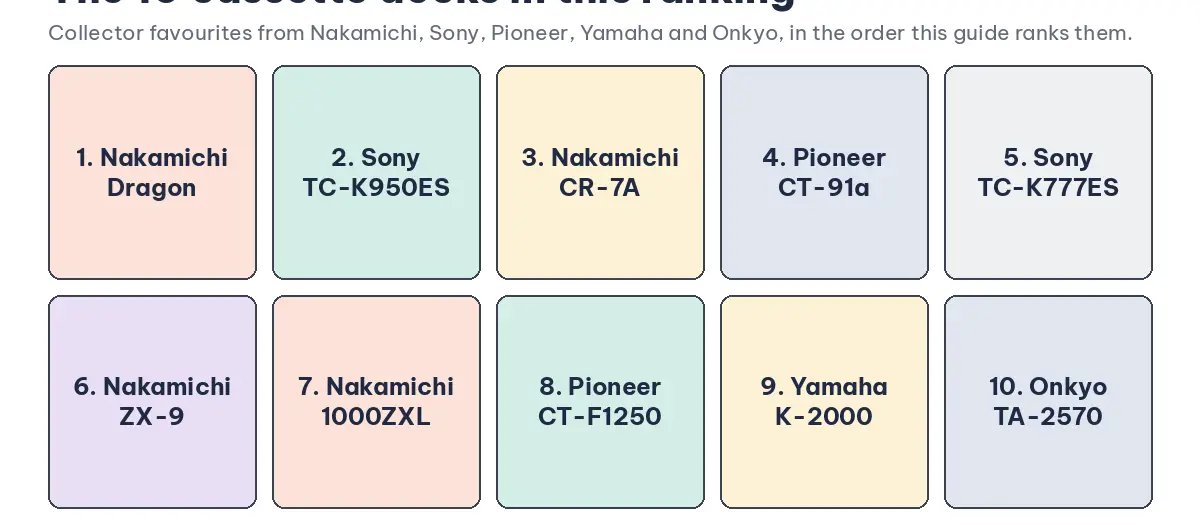
The Nakamichi Dragon is widely considered the best cassette deck ever made, and it now commands collector prices, but several other models deserve serious consideration for audiophiles and collectors. Here’s your complete guide to the greatest cassette decks ever produced, ranked by performance, collectibility and market value.
What Makes a Great Cassette Deck?
The cassette deck market peaked in the 1980s and early 1990s, producing legendary machines that remain technically superior to anything manufactured today. Understanding what separates exceptional decks from mediocre ones helps explain why collectors pay thousands for vintage units.
Key Technical Differentiators:
- 3-head design: Separate erase, record, and playback heads for superior performance
- Direct drive mechanisms: Precision motors with minimal wow and flutter
- Dual capstan transport: Even tape tension and reduced tape wear
- Advanced Dolby systems: B, C, and S noise reduction for clean recordings
- Discrete component construction: Individual transistors vs. integrated circuits
- Heavy, rigid chassis: Vibration isolation and component stability
These technical advantages created measurable differences in frequency response, signal-to-noise ratio, and dynamic range that digital formats have only recently matched. The best vintage decks achieve specifications that remain impressive by modern standards.
The Collector Market Today
The vintage cassette deck market has experienced strong growth in recent years, with prices for premium models rising. This surge reflects growing recognition of analog audio quality, nostalgia economics, and the simple reality that no one makes high-end cassette decks anymore.
Current Market Dynamics:
- Nakamichi Dragon and other Nakamichi flagships
- High-end Sony ES models
- Professional studio decks
- Quality consumer models
- Restoration services (costs vary widely by deck and fault; get a quote first)
This appreciation reflects legitimate scarcity—the best decks were expensive when new, produced in limited quantities, and many have succumbed to component aging or poor maintenance over 30+ years.
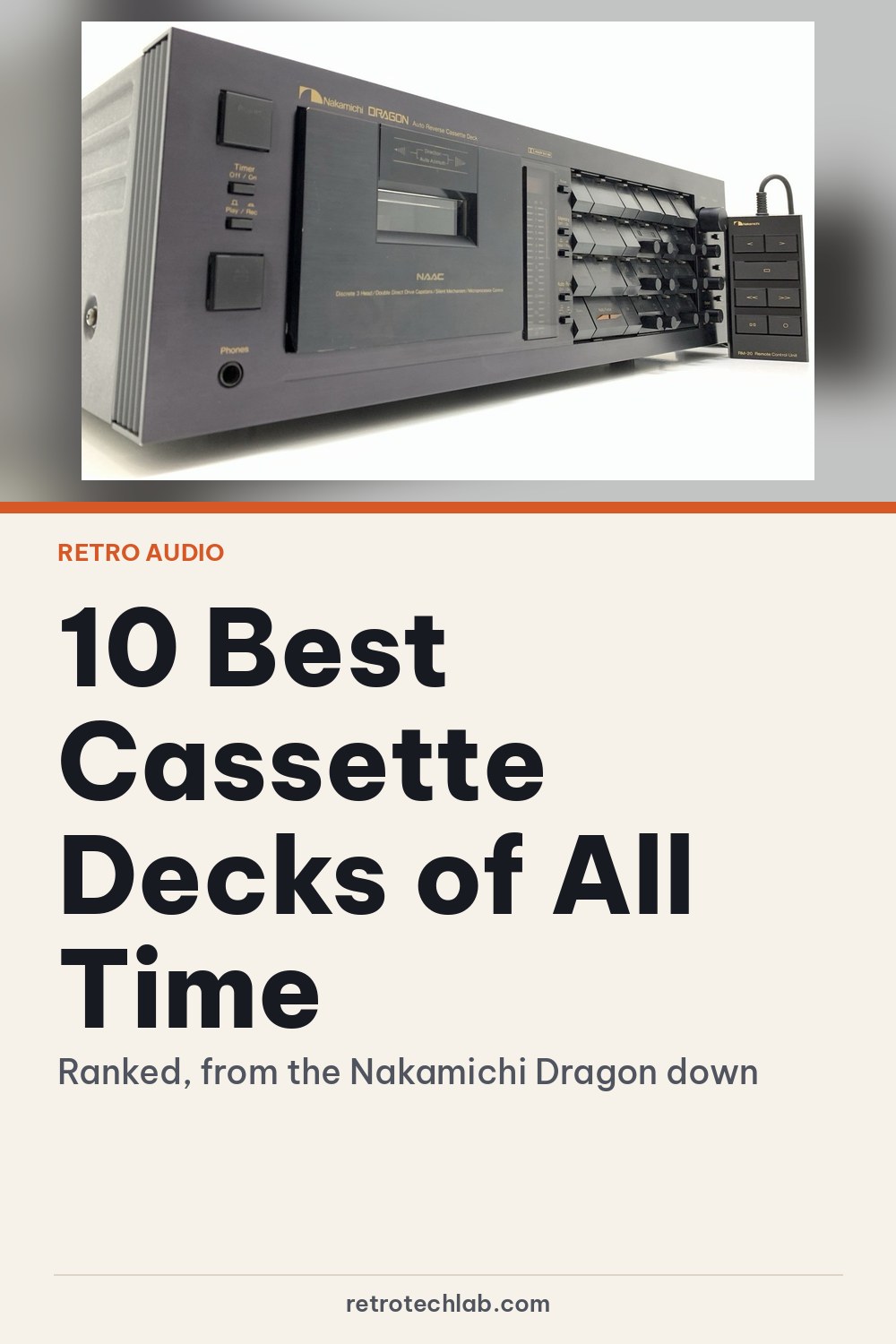
Top 10 Greatest Cassette Decks Ever Made
Our ranking considers technical performance, build quality, collectibility, and current market value. Each model represents the pinnacle of cassette technology from its respective manufacturer.
Specifications are manufacturer figures, taken from original brochures, contemporary reviews and reference sites (hifi-wiki, HiFi Engine, AnalogAudio). Production years are as listed by those sources and can vary by market.
1.Nakamichi Dragon
Why It’s #1: The Dragon was the first dual-capstan, double-direct-drive auto-reverse cassette deck. Its NAAC (Nakamichi Auto Azimuth Correction) system senses the azimuth of the recording and moves the playback head to match it, in both directions, so tapes made on other decks play back with full treble. It records in the forward direction and plays in both.
Years: Introduced in 1982 (Nakamichi brochure; reviewed in Audio, May 1983, at a US list price of $1,850).
Technical Specifications:
- Frequency response: 20Hz to 21kHz, or 20Hz to 22kHz with metal tape (manufacturer spec)
- Signal-to-noise ratio: 66dBA with Dolby B, 72dBA with Dolby C
- Wow & flutter: 0.019% WRMS
- Two SLT direct-drive capstan motors, one per capstan
- NAAC automatic playback-head azimuth correction
What to Look For: Dragons are mechanically complex. Check smooth auto-reverse operation, a working NAAC system, clean displays and proper tape transport. Factor in the cost of professional restoration if needed, and get a quote before you buy.
Dragon accessories: Original Remote Controls
2.Sony TC-K950ES
Why It’s Elite: Sony’s ES (Elevated Standard) flagship of its era, with three separate heads for off-tape monitoring, a closed-loop dual-capstan transport with quartz-locked direct drive, and bias, level and recording-EQ calibration.
Years: Made from about 1990 to 1992 (hifi-wiki; HiFi Engine lists it as 1989 to 1991).
Technical Specifications:
- Frequency response: 15Hz to 22kHz (metal tape)
- Signal-to-noise ratio: 76dB (Dolby C)
- Wow & flutter: 0.024%
- Dolby B, Dolby C and Dolby HX Pro
- Laser-amorphous playback head, separate record and erase heads
Collector Value: ES models hold their value well thanks to Sony’s reputation and robust construction. Units with original packaging, the remote and documentation sell for more.
Sony ES accessories: Audio Cables
3.Nakamichi CR-7A
Why It’s Legendary: The CR-7A is a discrete three-head deck with a direct-drive dual-capstan transport, automatic calibration and a manual playback-azimuth fine-tuning control. That last feature makes it a favourite for transferring old tapes recorded on other machines.
Years: Made from 1986 to 1993 (HiFi Engine; reviewed in Audio, August 1986, at a US list price of $1,350).
Technical Specifications:
- Frequency response: 18Hz to 21kHz ±3dB
- Signal-to-noise ratio: 66dBA with Dolby B, 72dBA with Dolby C
- Wow & flutter: 0.027% WRMS
- Crosstalk: -60dB
- Discrete three-head design with manual playback azimuth adjustment
Investment Potential: The CR-7A is one of the most sought-after Nakamichi decks, and complete examples with original manuals and accessories command a premium. Check recent sold listings for current values.
4.Pioneer CT-91a
Why It’s Exceptional: Pioneer’s late-1980s three-head flagship, part of its Urushi-finish range, combines Dolby B, Dolby C and HX Pro with very low wow and flutter.
Years: Introduced in 1989 (cazdec; hifi-wiki lists production from 1989 to 1991).
Technical Specifications:
- Frequency response: 15Hz to 23kHz (metal tape)
- Signal-to-noise ratio: 79dB (Dolby C)
- Wow & flutter: 0.022% WRMS
- Three heads, Dolby B/C and HX Pro
Hidden Gem Status: CT-91a models usually sell for less than comparable Nakamichi decks, which makes them a good choice for serious listeners on realistic budgets.
Pioneer maintenance: Replacement Belt Kits
5.Sony TC-K777ES
Why It’s Coveted: An early-1980s ES flagship with three heads, a dual-capstan transport and quartz-locked direct drive, built to a standard that still impresses technicians today.
Years: Made from about 1983 to 1985 (hifi-wiki).
Technical Specifications:
- Frequency response: 10Hz to 20kHz (metal tape)
- Signal-to-noise ratio: 74dB (Dolby C)
- Wow & flutter: 0.02%
- Three heads, dual capstan, quartz-locked direct drive
- Dolby B and Dolby C
Best Value Proposition: A K777ES in good order offers flagship-level engineering, though at 40 years old most need belts and a service.
6.Nakamichi ZX-9
Why It’s Desirable: The ZX-9 offers classic Nakamichi three-head engineering without the Dragon’s auto-reverse complexity. It has a direct-drive dual capstan, built-in calibration and a manual record-azimuth control.
Years: Made from 1982 to 1985 (hifi-wiki).
Technical Specifications:
- Frequency response: 20Hz to 21kHz
- Signal-to-noise ratio: 66dB with Dolby B, 72dB with Dolby C
- Wow & flutter: under 0.022%
- Three heads, three motors, direct-drive dual capstan
- Bias and level calibration with a test-tone generator, plus manual record-azimuth control
Market Position: The ZX-9 delivers much of the Dragon’s performance for less money, which keeps demand strong. Check recent sold listings for current values.
7.Nakamichi 1000ZXL
Why It’s Remarkable: Nakamichi’s computer-calibrated flagship of the early 1980s. Its A.B.L.E. system automatically optimises azimuth, bias, level and EQ for the tape in use.
Years: Introduced in 1980 (audio-heritage.jp; reviewed in Audio, June 1981).
Technical Specifications:
- Frequency response: 18Hz to 25kHz ±3dB (manufacturer spec)
- Wow & flutter: 0.04% WRMS
- A.B.L.E. automatic calibration
Collector Appeal: The 1000ZXL is rare and complex, so buy from a seller who can show it working, and budget for a specialist service.
8.Pioneer CT-F1250
Why It’s Respected: A late-1970s Pioneer flagship with three heads, a closed-loop transport and quartz-locked direct-drive capstan, plus pitch control and recording-EQ calibration.
Years: Introduced in 1979 (AnalogAudio handbook of cassette decks).
Technical Specifications:
- Frequency response: 25Hz to 18.5kHz ±3dB
- Signal-to-noise ratio: 69dB with Dolby B
- Wow & flutter: 0.03% WRMS
- Three heads, closed-loop transport, quartz direct-drive capstan
- Dolby B noise reduction
Buying Tip: Being older and Dolby B only, the CT-F1250 usually costs less than mid-1980s flagships. It is a good choice if you mostly play pre-recorded or Dolby B tapes.
Maintenance: Service Manuals and Parts
9.Yamaha K-2000
Why It’s Excellent: Yamaha’s early-1980s flagship pairs three heads and a direct-drive capstan with automatic tape-type selection and a built-in calibration computer. Unusually, it offers dbx noise reduction alongside Dolby B, rather than Dolby C.
Years: Made from 1982 to 1984 (hifi-wiki).
Technical Specifications:
- Frequency response: 20Hz to 20kHz ±3dB (metal tape)
- Wow & flutter: 0.02% WRMS
- Three heads, two motors, direct-drive capstan
- Dolby B and dbx noise reduction
Value Champion: K-2000 models often sell for less than Nakamichi or Sony ES flagships, though tapes recorded with dbx need a dbx-equipped deck to play back correctly.
10.Onkyo TA-2570
Why It’s Notable: The TA-2570, from Onkyo’s Integra series, shows that three-head performance was available at more modest prices in the late 1980s. It has a double-capstan drive and automatic Accubias tape calibration.
Years: Made from 1988 to 1990 (hifi-wiki).
Technical Specifications:
- Frequency response: 15Hz to 21kHz (metal tape)
- Wow & flutter: 0.035% WRMS
- Three heads (two hard-permalloy, one ferrite erase), three motors
- Dolby B and Dolby C
- Automatic Accubias calibration and automatic tape-type selection
Budget Excellence: TA-2570 models remain affordable while offering genuine three-head off-tape monitoring, which makes them a good entry point.
Budget deck accessories: Cleaning and Maintenance Kits
Comprehensive Buying Guide
The vintage cassette deck market requires careful navigation due to age-related issues, restoration costs, and rapidly changing prices. Understanding what to look for—and what to avoid—ensures successful purchases.
Where to Find Quality Cassette Decks
Online Marketplaces
- eBay: Largest selection, highest prices, buyer protection
- Reverb: Music equipment focus, professional sellers
- AudiogoN: Audiophile community, premium models
- Facebook Marketplace: Local deals, inspection opportunities
Specialized Sources
- Audio restoration services: Guaranteed working condition, premium pricing
- Estate sales: Original owners, potential bargains
- Audio swap meets: Enthusiast community, negotiable pricing
- Professional audio dealers: Curated selection, expert knowledge
Critical Inspection Points
Mechanical Condition:
- Smooth tape transport operation
- Proper fast-forward and rewind function
- Clean, aligned tape heads
- Functional meters and displays
- Original remote control and documentation
Audio Performance:
- Clean playback without dropouts
- Proper channel balance and separation
- Functional Dolby noise reduction
- Accurate bias adjustment
- Low noise floor and distortion
Testing equipment: Professional Test Tapes
Red Flags to Avoid
Deal Breakers:
- Seized or erratic transport mechanisms
- Corroded or damaged tape heads
- Missing or broken loading mechanisms
- Significant electronic modifications
- Water damage or severe cosmetic deterioration
Restoration vs. Original Condition
The restoration decision significantly impacts both cost and collectible value. Understanding when restoration makes sense—and when to avoid it—is crucial for smart purchasing.
Typical Professional Restoration Costs (rough guide; prices vary widely by technician and region):
- Basic service (belts, cleaning, calibration)
- Complete recap (capacitor replacement)
- Full restoration (mechanical and electronic)
- Specialty work (Dragon auto-reverse repair)
Original vs. Restored Value: Completely original, unserviced decks often command premium prices from collectors, even if they require restoration. However, professionally restored units offer immediate enjoyment and often include service warranties.
Cassette Tape Types: Matching Tape to Deck
A great deck only performs at its best with the right tape and settings. Cassettes come in four types, and each needs different bias and playback EQ:
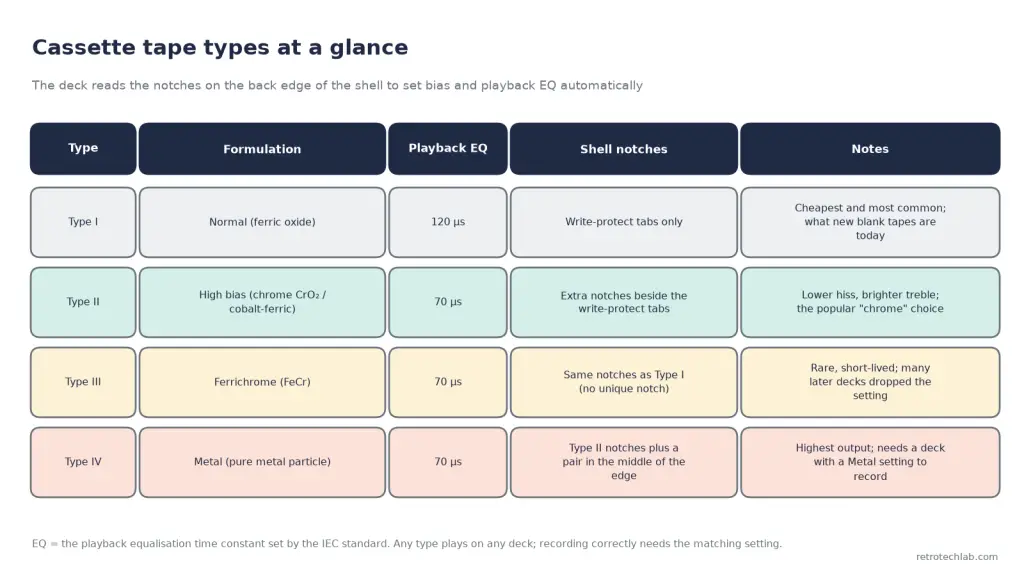
| Type | Formulation | Playback EQ | Notes |
|---|---|---|---|
| Type I (Normal) | Ferric oxide | 120 µs | The most common type; works in every deck |
| Type II (High bias) | Chrome or cobalt-doped ferric | 70 µs | Lower hiss and better treble than Type I |
| Type III | Ferrichrome | 70 µs | Rare, and long obsolete; many decks lack the setting |
| Type IV (Metal) | Metal particle | 70 µs | Best high-frequency headroom; needs a deck with a metal setting |
Most decks from the 1980s detect the type automatically from the notches on the top edge of the cassette shell. Older decks have manual switches for bias and EQ. Using the wrong setting doesn’t damage anything, but recordings sound dull or harsh, and playback sounds too bright or too muffled. Our guide to bias, EQ and cassette optimisation explains how to get the most from each type.
Two-Head vs Three-Head Decks
- Two-head decks use one combined record/playback head plus an erase head. The head gap has to be a compromise between recording and playback, which limits treble performance.
- Three-head decks have separate record and playback heads. Each head can be optimised for its job, and you can monitor the recording off the tape as you make it, which is ideal for calibrating bias and level. Nakamichi made the approach famous with the Nakamichi 1000 in the 1970s.
- Discrete vs combination heads: some 3-head decks put the record and playback heads in one housing, while discrete designs such as Nakamichi’s use separate head blocks.
Dual-Capstan and Three-Motor Transports
The transport, the mechanism that moves the tape, matters as much as the heads:
- Dual-capstan (closed-loop) transports grip the tape with capstans on both sides of the heads. This keeps tension steady across the heads and reduces flutter and modulation noise.
- Three-motor decks use separate motors for the capstan, the reels and often the mechanism, with logic controls. That gives smoother operation and gentler tape handling than single-motor designs, which rely on belts and idlers.
The downside is more parts to service. Belts, idlers and pinch rollers in any vintage deck will need attention eventually.
Azimuth: Why Some Tapes Sound Dull
Azimuth is the angle of the head gap relative to the tape. If the playback head isn’t at exactly the same angle as the head that recorded the tape, treble is lost and stereo imaging smears. That’s why a tape recorded on one deck can sound dull on another.
- The Nakamichi Dragon corrects playback azimuth automatically, which is one reason it’s so highly regarded.
- Some high-end decks let you adjust record azimuth to match the playback head.
- On most other decks, azimuth is set with a small screw beside the head, using a test tape or by ear for maximum treble.
Read our guide to tape deck azimuth alignment for the full procedure. If you’re buying, check our cassette deck value guide.
Modern Alternatives and Why Vintage Remains King
Several companies still manufacture cassette decks, but none approach the performance or build quality of vintage flagships from the format’s golden age.
Current Production Models
New Decks You Can Still Buy (check current prices; availability changes):
- TEAC W-1200: Basic dual-well design, consumer-grade performance
- Marantz PMD-300CP: combined CD player and cassette deck for rack or desktop use
- Tascam 202mkVII: Studio utility deck, rack-mountable
- Ion Tape Express Plus: USB conversion focus, basic quality
Why Vintage Dominates: Modern decks use cost-reduced designs, lower-grade components, and simplified circuitry. Even the best contemporary models cannot match the engineering excellence and component quality of 1980s flagships.
Vintage Advantages:
- Discrete component construction vs. integrated circuits
- Heavy, rigid chassis vs. lightweight plastic
- Professional-grade tape transport mechanisms
- Superior head materials and manufacturing precision
- Advanced bias and equalization systems
Essential Accessories and Supplies
Maximizing cassette deck performance requires quality accessories, proper maintenance supplies, and compatible media. The right accessories can transform good performance into exceptional results.
High-Quality Blank Cassettes
Premium Tape Recommendations:
- TDK SA-X: Chrome equivalent, excellent high-frequency response
- Maxell XLII-S: High-bias formulation, outstanding dynamic range
- Sony UX-Pro: Professional chrome, studio-grade performance
- BASF Chrome Extra II: Reference standard for critical recording
Premium cassette tapes: Chrome and Metal Cassette Selection
Maintenance and Cleaning Supplies
Essential Maintenance Kit:
- Demagnetizing cassettes for head maintenance
- Head cleaning cassettes and solutions
- Precision screwdriver sets for adjustment
- Contact cleaner for switches and connectors
- Replacement belts for common models
Professional maintenance: Complete Maintenance Kit
Audio Cables and Connections
Quality interconnect cables significantly impact performance, especially with high-end decks capable of resolving subtle differences in signal transmission.
Recommended Cable Types:
- Oxygen-free copper (OFC) interconnects
- Shielded cables for low-noise operation
- Gold-plated connectors for corrosion resistance
- Appropriate cable length to minimize signal degradation
Premium audio cables: High-End Interconnect Cables
Storage and Organization
Proper Storage Solutions:
- Climate-controlled environment (65-70°F, 45-50% humidity)
- Vertical tape storage to prevent pack shifting
- UV-resistant storage boxes and cases
- Dust covers for deck protection
- Cataloging systems for large collections
Storage solutions: Professional Tape Storage Systems
Budget-Based Buying Strategies
Different budget levels access different tiers of the vintage cassette market. Understanding what’s possible at each price point helps set realistic expectations and maximize value.
Entry Level
Target Models: Onkyo TA-2570, Yamaha K-720, Sony TC-K511S
Strategy: Focus on working condition over cosmetics, accept minor issues
Expectations: Good performance, reliable operation, entry into audiophile territory
Enthusiast Level
Target Models: Sony TC-K777ES, Yamaha K-2000, Pioneer CT-91a
Strategy: Seek excellent condition examples, consider restoration costs
Expectations: High-end performance, collectible potential, long-term satisfaction
Collector Level
Target Models: Nakamichi ZX-9, Sony TC-K950ES, Nakamichi CR-7A
Strategy: Demand exceptional condition, verify authenticity, consider investment potential
Expectations: Reference-quality performance, strong resale value, pride of ownership
Investment Level
Target Models: Nakamichi Dragon, rare limited editions, museum-quality examples
Strategy: Verify provenance, demand original accessories, consider professional inspection
Expectations: Ultimate performance, significant appreciation potential, legendary status
Market Trends and Investment Potential
The vintage cassette deck market shows strong fundamentals for continued appreciation, driven by format revival, collector interest, and finite supply of premium models.
Positive Market Drivers:
- Cassette format revival among younger listeners
- Nostalgia economics from 1980s generation
- Recognition of analog audio superiority
- No new production of comparable quality
- Component aging reducing available supply
Price trends: prices for flagship Nakamichi, Sony ES and high-end Pioneer decks have risen noticeably in recent years. Check recent sold listings for current values, because prices vary a lot with condition and service history.
Investment Outlook: Premium models from established manufacturers show continued appreciation potential, particularly examples in exceptional condition with original accessories and documentation.
Frequently Asked Questions
Which Cassette Deck Has the Best Sound Quality?
The Nakamichi Dragon and CR-7A represent the pinnacle of cassette audio quality, with the Dragon’s auto-reverse convenience versus the CR-7A’s slightly superior single-direction performance. Sony’s TC-K950ES offers similar three-head, dual-capstan engineering.
Are Nakamichi Decks Worth the High Prices?
Nakamichi decks justify premium pricing through superior engineering, exceptional build quality, and proven longevity. However, returns diminish at the top: models such as the ZX-9 offer much of the Dragon’s performance for considerably less.
What Should I Pay for a Vintage Cassette Deck?
Pricing depends on model, condition, and market timing. Quality consumer decks cost the least, high-end models more, and flagship units the most; check recent sold listings (for example, eBay sold items) for current values. Always factor restoration costs into purchase decisions.
Do Modern Cassette Decks Compare to Vintage Ones?
No modern cassette deck approaches the performance or build quality of 1980s flagships. Contemporary models use cost-reduced designs and cannot match the engineering excellence of vintage reference units.
How Do I Maintain a Vintage Cassette Deck?
Regular maintenance includes head cleaning, demagnetizing, belt replacement (every 5-10 years), and capacitor replacement (every 15-20 years). Store in climate-controlled environments and use quality tapes to minimize wear.
Which Brands Offer the Best Value?
Pioneer and Yamaha models often provide exceptional performance at lower prices than equivalent Nakamichi or Sony units. TEAC offers professional reliability, while Onkyo delivers audiophile quality at consumer pricing.
Should I Buy Restored or Original Condition?
Professional restoration ensures immediate functionality and often includes warranties. However, original unserviced decks may command collector premiums. Consider your intended use—listening versus collecting—when deciding.
What is the difference between a 2-head and a 3-head cassette deck?
A 2-head deck uses a combined record/playback head, while a 3-head deck has separate record and playback heads. Each can then be optimised for its job, and you can monitor recordings off the tape as you make them.
What is azimuth on a cassette deck?
Azimuth is the angle of the head gap relative to the tape. If it doesn’t match the deck that recorded the tape, treble is lost and the sound becomes dull. The Nakamichi Dragon corrects it automatically; most decks have a small adjustment screw.
Which cassette tape type is best?
Type IV metal tapes have the most high-frequency headroom, and Type II chrome tapes offer low hiss at a lower cost. Type I normal tapes work in every deck. Use the type your deck supports and set bias and EQ to match.
The Future of Cassette Deck Collecting
The vintage cassette deck market shows strong fundamentals for continued growth and appreciation. Limited supply, growing demand, and format revival create ideal conditions for collector interest.
What to expect:
- Continued strong interest in flagship models
- Growing interest in mid-tier decks as flagship prices climb
- Increased demand for restoration services
- Stabilization of prices for common consumer models
- Growing recognition of cassette format’s artistic merits
The cassette deck renaissance represents more than nostalgia—it’s recognition that the format’s golden age produced technical achievements that remain impressive by modern standards. Whether you’re seeking the ultimate in analog audio reproduction or building a collection of historically significant equipment, the decks featured in this guide represent the absolute pinnacle of cassette technology.
Essential Shopping List for Cassette Enthusiasts
Ready to enter the world of high-end cassette decks? Here’s your complete shopping guide:
Deck Categories by Budget:
Essential Accessories:
Storage and Organization:
Testing and Calibration:
Conclusion: Preserving the Golden Age of Analog Audio
The cassette decks featured in this guide represent the absolute pinnacle of analog audio engineering, achieving performance levels that remain impressive by modern digital standards. From the legendary Nakamichi Dragon to exceptional values like the Yamaha K-2000, each model demonstrates why the 1980s are considered the golden age of cassette technology.
Whether you’re seeking reference-quality audio reproduction, building a collection of historically significant equipment, or simply wanting to experience music as artists intended during the cassette era, these decks deliver performance that modern alternatives cannot match.
The vintage cassette deck market today offers opportunities for both music lovers and collectors, with strong fundamentals supporting continued appreciation for quality examples. Understanding the technical differences, market realities, and maintenance requirements ensures successful navigation of this specialized but rewarding market.
Investment in vintage cassette technology represents more than acquiring audio equipment—it’s preserving a pinnacle of analog engineering that may never be equaled. These remarkable machines deserve recognition not just as nostalgic artifacts, but as technical achievements that pushed analog audio to its absolute limits.
Remember: All Amazon links use tracking ID retrotechlab-20 to support this content. Vintage cassette deck prices and availability change rapidly in the current collector market.