CRT TVs stopped being made in volume in the late 2000s, so every set you can buy today is second-hand and 15 to 30 or more years old. Prices have climbed since retro gaming made them desirable again. Even so, a perfectly good tube TV can still turn up for little or nothing if you know where to look and what to check. This guide covers where to find a CRT TV in the UK and the US, what typically separates a £20 set from a £1,000 monitor, and how to avoid bringing home a heavy, broken one.
Quick answer: look locally first: Facebook Marketplace, Gumtree or Craigslist, plus charity, thrift and reuse shops. Search for “old TV”, “tube TV” or “Sony TV” rather than “CRT”. Expect to collect it yourself and test it before paying. Use eBay and specialist retro sellers when you want a specific, tested model and are happy to pay more for it.
If you are still deciding which set suits your consoles, start with our guide to the best CRT TVs for retro gaming, and our Sony Trinitron vs JVC D-Series comparison if you are choosing between the two most sought-after consumer lines.
Where to buy a CRT TV
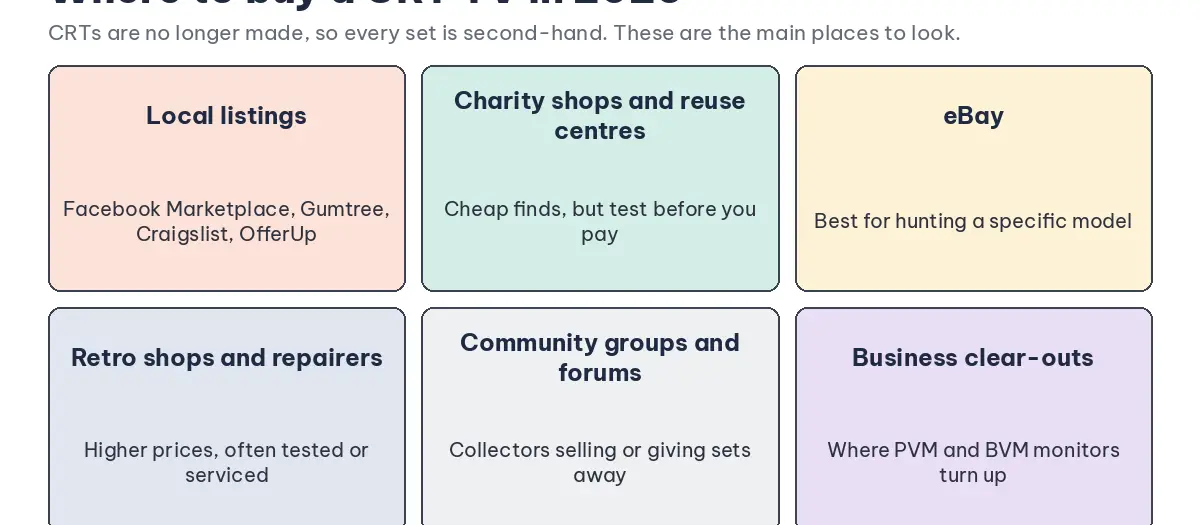
1. Local listings: Facebook Marketplace, Gumtree, Craigslist, OfferUp
This is where most cheap and free sets are found, on both sides of the Atlantic. Many sellers simply want an old, heavy TV gone and don’t know it has any retro-gaming value. Some tips:
- Search like a non-collector. Try “old TV”, “tube TV”, “vintage TV”, “Sony TV”, “Panasonic TV”, “JVC TV” and “free TV”. Listings titled “CRT” or “retro gaming TV” are usually priced by someone who has checked what they sell for.
- Check often and act quickly. Free sets usually go to whoever turns up first.
- Set a sensible radius. A 27-inch or larger set rarely survives courier shipping well, so plan on collecting it yourself.
- Ask for a photo of the rear label and the back panel. The model number and inputs tell you most of what you need to know before you travel.
2. Charity shops, thrift stores and reuse centres
In the US, Goodwill, Salvation Army and independent thrift stores still take in CRTs in some areas, and ShopGoodwill’s online auctions sometimes list them for local pickup. In the UK, policies vary: many charity shops no longer accept old TVs, but larger furniture-and-electrical charity stores and some council reuse shops do sell tested electricals. Call ahead rather than assuming.
3. eBay (best used for specific models)
eBay is rarely the cheapest source for a big consumer CRT, but it is useful when you want a particular model. Filter for collection only or local pickup and sort by distance; shipped large sets are expensive and risky. Smaller sets (14 to 20 inches) and professional monitors are shipped more often, so check that the seller double-boxes them and describes how they were tested. Always check sold listings rather than asking prices to see what a model really goes for.
4. Retro game shops, repairers and specialist sellers
Independent retro game shops, TV and arcade repairers, and specialist CRT sellers often stock tested sets, sometimes with a short warranty. You pay more, but you are paying for someone else to have checked the tube, geometry and power supply. That is worth it for a first CRT, or when you need a set that works on day one.
5. Community groups and forums
Retro gaming Facebook groups, Discord servers, local retro gaming events and communities such as r/crtgaming regularly have members selling or giving away sets, often with honest descriptions of their faults. This is also one of the better places to find professional monitors sold by enthusiasts.
6. Surplus and business clear-outs (for PVMs and BVMs)
Sony PVM and BVM professional monitors came from TV studios, edit suites, hospitals and universities. They still turn up at broadcast and AV equipment dealers, business-surplus auctions and university or hospital surplus sales, though far less often than ten years ago.
UK vs US: what’s different
- UK and European sets usually have SCART, and many SCART sockets accept RGB, the sharpest signal most retro consoles can output over a standard cable. That makes an ordinary 1990s UK TV a much better retro display than its US equivalent. Not every SCART socket is RGB-wired, so check the manual or test with an RGB cable.
- US consumer sets almost never have RGB. Look for S-Video (fine for SNES, N64 and similar) and, on later sets from around 1999 onwards, component (YPbPr) inputs for PS2, GameCube, Wii and original Xbox.
- 50 Hz vs 60 Hz. Many later UK sets also display 60 Hz signals, which matters for imported or modded consoles and for some modern devices. Older or budget sets may roll or lose colour, so test with the console you plan to use.
- Distances and vehicles. US buyers often face longer drives for local pickups. UK buyers more often hit tight stairs and small cars. Either way, measure the set and your car before you go.
What to pay: typical price ranges
CRT prices vary a lot by region, condition and how much the seller knows. The ranges below are typical figures from recent listings and buyer guides, not guarantees. Check local sold prices before you commit. For a deeper breakdown, see how much you should pay for a CRT TV.
| Type of set | Typical price (local, working) | Notes |
|---|---|---|
| Common 14 to 21-inch consumer TV (any brand) | Free to about £/$50, more for Sony | Often given away. Small Trinitrons sell for more: working 14-inch Sony sets were listed for roughly £80 to £125 in the UK in 2026. |
| 20 to 27-inch Sony Trinitron or JVC (consumer) | Roughly $100 to $300 / similar in £ | Sets with component or RGB inputs and good geometry sit at the top of the range. |
| Tested, serviced or recapped consumer set | Roughly $250 to $500+ | You pay for someone else’s testing time; sometimes with a short warranty. |
| Large flat-screen (FD Trinitron / WEGA) 27 to 36-inch | Roughly $250 to $650, wide spread | Very heavy (32 to 36-inch sets can weigh 70 to 100 kg or more). Desirable models such as Sony’s KV-FV310 series command a premium. |
| Sony PVM, 14-inch | Roughly $350 to $950 | Depends on model (e.g. 14M2/14M4 vs medical or lower-line units) and tube hours. |
| Sony PVM, 20-inch | Roughly $600 to $1,800 | Higher-resolution and multiformat models (such as the PVM-20L5) can go well beyond this. |
| Sony BVM broadcast monitors | Often $1,500+ | Enthusiast tier; condition and controller availability matter a lot. |
UK prices for professional monitors tend to track US prices once converted, and there are fewer of them about. Treat any range here as a starting point for negotiating, not a fixed value. If you want to understand what drives value up or down, our Sony Trinitron value guide and guide to whether a PVM is worth it go into more detail.
Consumer TV, PVM or BVM?
- Consumer TV: cheapest, bigger screens, softer picture that many people prefer for 8 and 16-bit games. The best choice for most players and for multiplayer on the sofa.
- PVM: sharper, with RGB and component inputs on many models and more visible scanlines. Usually 14 or 20 inches. Great for a desk setup, but costs several times more.
- BVM: top-end broadcast monitors with very fine detail. Expensive, and arguably overkill unless you want the sharpest possible image.
Trinitron is Sony’s aperture-grille tube design, known for a bright, sharp image. It is not the only good option. JVC, Panasonic, Toshiba and Philips made excellent sets too, and they often cost less because fewer people search for them by name.
What to check before you pay
Bring a console or a portable video source and the right cable, and ask to see the set warmed up for 10 to 15 minutes. Our full CRT testing checklist covers this in depth. The essentials are:
- Inputs: confirm the ones you need (RGB SCART, S-Video, component) actually work, not just that the sockets exist.
- Geometry: look for straight edges and a centred picture without bowing, tilting or wobble.
- Colour and purity: check a plain white or grey screen for coloured blotches, and look for colours bleeding past their edges.
- Brightness and focus: a dim or blurry image that needs the brightness turned right up can point to an aging tube.
- Burn-in: look for faint logos or tickers, especially on ex-shop or ex-studio monitors.
- Sound and smell: a loud buzz, crackling or a burning smell are reasons to walk away.
- Remote and menu: service-menu adjustments on many sets need the remote, and replacements are not always easy to find.
- Physical damage: check for cracked cases or a damaged rear neck area. Never buy a set that has obviously been dropped.
Safety: CRTs hold dangerous high voltages, even when unplugged. Don’t open the case unless you know how to discharge the tube safely. If a set needs internal work, our common CRT problems guide explains what is usually involved. Once you have a set home, our guides to calibrating a CRT TV and restoring an old CRT cover the next steps.
Getting it home
- Bring a second person for anything 27 inches or bigger, and carry the set screen-side towards your body, supporting it from underneath.
- Lay blankets in the car and transport it screen-down or upright and strapped in, never resting on the thin rear neck.
- Use a stand or cabinet rated for the weight; many modern TV units are not.
Useful accessories
The right cable makes a bigger difference to picture quality than almost anything else. These are search links, so you can compare current options for your console. Check reviews and the exact console model before buying. For background on which signal to use, see composite vs S-Video vs RGB and our best SCART cables guide.
- UK: RGB SCART cables and SCART switch boxes for running several consoles into one TV.
- US: S-Video cables for SNES and N64 and component cables for PS2 and Wii.
- Cleaning: contact cleaner for scratchy controls and dirty input sockets (UK: contact cleaner).
- No CRT yet? A line-doubler or upscaler such as the RetroTINK or OSSC makes old consoles look far better on a modern TV. Availability on Amazon varies, and some are sold mainly through the maker’s own store. See our HDMI upscaler guide.
As an Amazon Associate, RetroTech Lab earns from qualifying purchases. This doesn’t change the price you pay.
FAQ
Can you still buy a new CRT TV?
Not from mainstream brands. Production largely ended in the late 2000s, and any “new” set you see is old stock. Every CRT you buy today is effectively vintage.
What size CRT is best for retro gaming?
20 to 27 inches suits most rooms: big enough for the sofa, still movable by two people. Smaller sets are sharper-looking and easy to place on a desk. See our CRT size guide.
Are HD CRTs good for retro consoles?
Late HD CRTs are excellent for 480i/480p and 1080i sources, but some process every input internally. That can add lag and change how 240p games look. For pre-PS2 consoles, a standard-definition set is usually the safer choice.
Is a free CRT worth taking?
Usually, if it works and you have room for it. Just remember that disposing of a dead set later can cost money, so test it on the spot if you can.