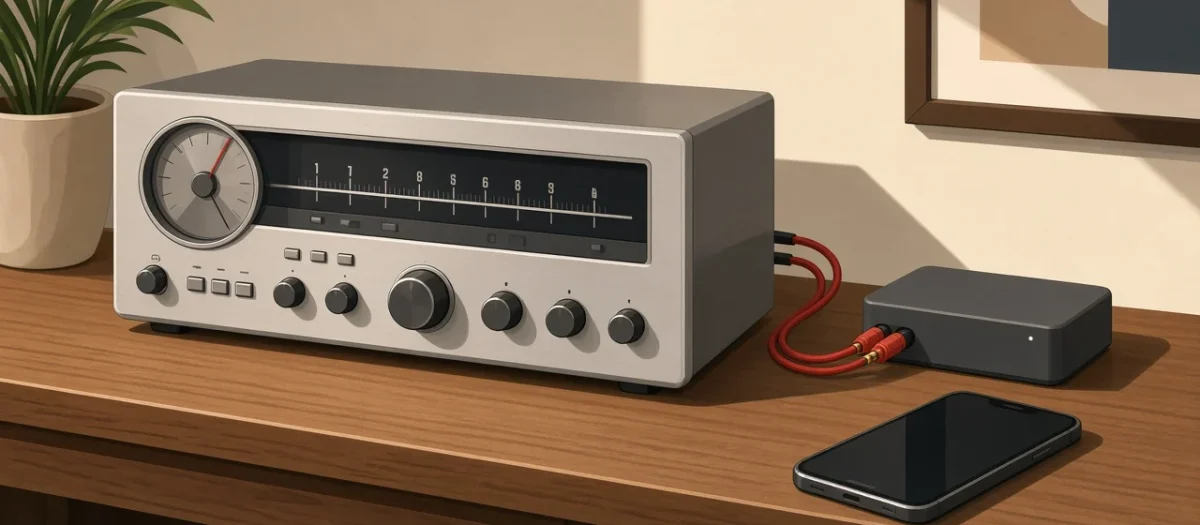
Quick answer: Plug a Bluetooth receiver (a small box that outputs line-level audio on RCA sockets) into a line-level input on the amp: AUX, Tape Play, Tuner or CD. Never use the Phono input, which is built for the tiny signal from a record cartridge and will sound loud, distorted and boomy. A budget receiver such as the 1Mii B06+ does the job; an audiophile-oriented one such as the Audioengine B1 adds a better DAC and an optical output. If you hear hum, power the receiver from a different USB adapter, or add a ground-loop isolator.
Affiliate links: if you buy through the Amazon links on this page we may earn a small commission at no extra cost to you. Prices change, so check the current price on Amazon.
The receiver specs below come from the manufacturers’ published information. We have not run listening tests, so we compare on specifications and features only.
Which input should you use on a vintage amp?
Old amplifiers have two kinds of input, and the difference is huge. Pioneer’s SX-780 receiver is a typical example: its manual lists the phono input at 2.5 mV sensitivity and the AUX and tape inputs at 150 mV. A Bluetooth receiver puts out line level; the Audioengine B1, for example, is rated at 2.0 V RMS full-scale output. That is about 13 times the AUX sensitivity and 800 times the phono sensitivity.
| Input on the amp | Use it for Bluetooth? | Why |
|---|---|---|
| AUX | Yes, first choice | Line level, no equalisation |
| Tape Play, Tape Monitor or Tape 2 | Yes | Line level. Press the Tape Monitor button to hear it on many receivers |
| Tuner (if the amp has a separate tuner input) | Yes | Line level |
| CD or Video | Yes | Line level |
| Phono | No | Built for about 2.5 mV with RIAA bass boost: heavy distortion and boom |
| Tape Rec or Tape Out | No | These are outputs |
Because the receiver’s output is well above what the AUX input needs for full power, you will use less of the volume knob than with a turntable. Start with the amp’s volume low, and set the phone’s volume to about three-quarters so you are not boosting noise.
What to look for in a Bluetooth receiver
- Outputs: RCA analogue for any vintage amp. An optical (Toslink) output is only useful if you also have an external DAC.
- Codecs: Bluetooth always supports SBC. aptX, aptX HD and aptX Adaptive are used by many Android phones; Apple devices use AAC. Choose a receiver that supports the codec your phone sends.
- Power: most receivers run from a 5 V USB adapter. A separate adapter, rather than a USB socket on another device, helps avoid hum.
- Range and placement: Bluetooth range drops through walls and furniture. Mount the receiver where it has a clear view of the room, not behind a metal amplifier case.
- Auto-reconnect: useful if several people pair with it.
Two receivers compared on published specs
| Spec | Audioengine B1 | 1Mii B06+ |
|---|---|---|
| Bluetooth version | 5.3 | 5.3 |
| Codecs | aptX Adaptive, aptX HD, aptX, AAC, SBC | aptX Adaptive, aptX HD, SBC (as listed) |
| Outputs | RCA and optical (S/PDIF) | RCA and 3.5 mm |
| DAC | ESS ES9018K2M | Not stated as a separate DAC |
| Rated range | Up to 100 ft (30 m) typical | Up to 98 ft (30 m) outdoors, less indoors (listing) |
| Power | 5 V, 200 mA | See listing |
| Published noise and distortion | SNR 104 dB, THD+N under 0.03% | Not published in the listing |
Sources: Audioengine B1 technical specifications; 1Mii B06+ Amazon listing. Audioengine says the B1 remembers up to six devices but connects to one at a time, and quotes latency of about 80 ms, which is fine for music but may be noticeable with video.
Which to choose: the 1Mii B06+ covers the basics for a kitchen or workshop system. The Audioengine B1 is the better fit for a good vintage system or an iPhone (it supports AAC), and for anyone who wants to feed an external DAC by optical.
- 1Mii B06+ Bluetooth receiver: check current price.
- Audioengine B1 Bluetooth receiver: check current price, and check the listing says Bluetooth 5.3.
How to connect it, step by step
- Switch the amp off and turn the volume down.
- Connect the receiver’s RCA outputs to the amp’s AUX (or Tape Play) inputs: red to right (R), white to left (L).
- Power the receiver from its own USB adapter at the wall.
- Switch on the amp, select AUX (or press Tape Monitor), then pair your phone with the receiver.
- Play something quiet, then raise the amp’s volume slowly.
Fixing hum, hiss and dropouts
| Problem | Likely cause | Fix |
|---|---|---|
| Hum or buzz that changes when you touch the cable | Ground loop between the receiver’s power and the amp | Use a different USB adapter, plug both into the same wall socket, or add a ground-loop isolator on the RCA lead |
| Whine that changes with the music or Bluetooth activity | Noise from a shared or poor power supply | Power the receiver from a separate, better adapter. Retronics describes using an isolated DC-DC converter when sharing a supply |
| Distorted or very loud even at low volume | Connected to Phono | Move to AUX or Tape |
| Crackles when you turn the volume knob | Dirty volume pot or input selector on the amp | Clean with contact cleaner. See our scratchy volume knob guide |
| Dropouts | Distance or obstacles | Move the receiver into the open, away from the amp’s metal case and Wi-Fi routers |
Other ways to add Bluetooth
- Tape deck or cassette adapter: a Bluetooth cassette adapter in a deck works, but the sound goes through the tape heads. A receiver on the AUX input is cleaner.
- Internal Bluetooth board: possible on some vintage radios, but it means opening a mains-powered set. Leave that to someone qualified.
- A streamer: a Wi-Fi streamer with RCA outputs adds multiroom and better quality, at a higher price.
Related guides
- Best vintage hi-fi amplifiers for beginners
- Vintage amplifiers explained
- Best vintage stereo receivers
- How to fix a scratchy volume knob
- Best affordable vintage amplifiers under $200
Sources: Audioengine B1 technical specifications; Pioneer SX-780 operating instructions, specifications page; Retronics: powering Bluetooth audio adapters; 1Mii B06+ product listing.
FAQ
How do I add Bluetooth to an old stereo?
Connect a Bluetooth receiver to a line-level input such as AUX, Tape Play or Tuner with an RCA cable, power it from a USB adapter, select that input and pair your phone.
Can I plug a Bluetooth receiver into the phono input?
No. The phono input expects a few millivolts from a cartridge and adds bass boost, so a line-level Bluetooth receiver will sound distorted and boomy. Use AUX or Tape.
Why does my Bluetooth receiver hum through my amp?
Usually a ground loop or a noisy USB power supply. Try a different adapter, plug both into the same wall socket, or fit a ground-loop isolator on the audio lead.
Which Bluetooth codec is best for an iPhone?
Apple devices use AAC, so choose a receiver that lists AAC support, such as the Audioengine B1.
Does Bluetooth sound worse than a cable?
Bluetooth compresses the audio, and how much depends on the codec. For casual listening most people find it fine; for the best quality use a wired source or a Wi-Fi streamer.