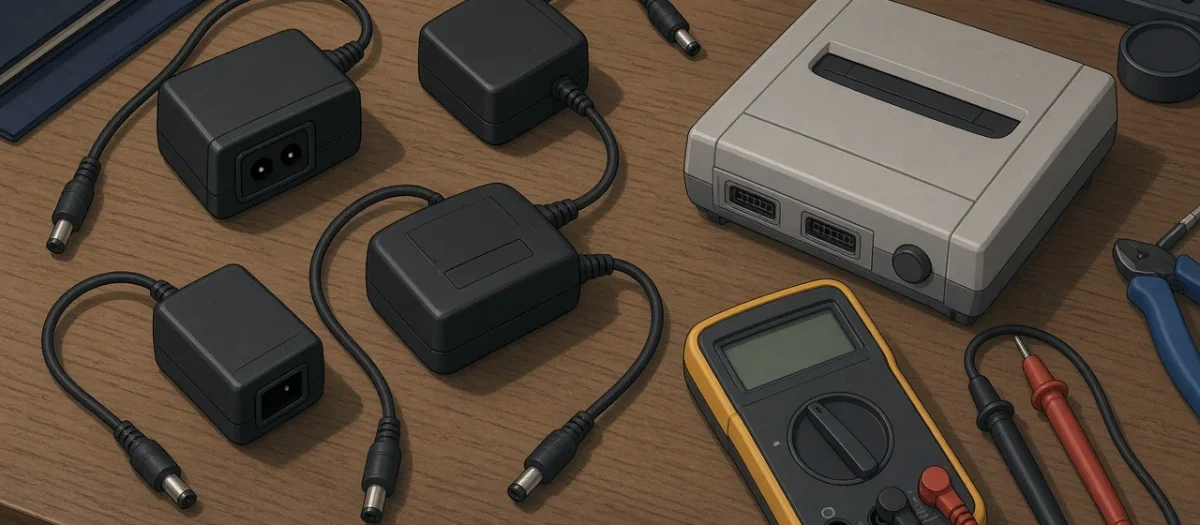
Quick answer: Match four things on the replacement: voltage, current (equal or higher), polarity and plug size. The big traps are polarity and region. A Mega Drive 1 wants 9 to 10 V DC centre-negative on a 5.5 x 2.1 mm plug, but a Mega Drive 2 wants 10 V DC centre-positive on a smaller EIAJ-3 plug, so the two are not interchangeable. A US SNES takes 10 V DC centre-negative, while a UK or European SNES and a NES run on 9 V AC. The N64, GameCube and Wii use proprietary multi-pin or Nintendo-only plugs, so buy a supply made for that console. In the UK, never plug a US 120 V adapter into the mains: an unregulated transformer gives roughly double its rated output on 230 V.
Affiliate links: if you buy through the Amazon links on this page we may earn a small commission at no extra cost to you. We link a multimeter only, because power supply listings change often; check any adapter against the table below before you buy.
The specs below come from the Console Power Supply Bible on the JunkerHQ wiki, which records the label details of original adapters, plus maru-chang’s hardware pages for the N64 and GameCube and Dig and Rescue’s power supply list. Read the label on your own console’s input as well: it is the final word.
Retro console power supply chart
| Console | Original adapter (region) | Output | Polarity | Plug |
|---|---|---|---|---|
| NES | NES-002 (US), NES-002E (EU) | 9 V AC, 1.3 A (EU: 9 to 9.4 V) | None (AC) | 5.5 x 2.1 mm |
| SNES | SNS-002 (US); EU uses NES-002E | US: 10 V DC, 850 mA; EU: 9 V AC | Centre negative (US) | Non-standard (US) |
| Super Famicom / Famicom | HVC-002 (JP) | 10 V DC, 850 mA | Centre negative | 5.5 x 2.1 mm |
| Master System 1 | 3025 (US), 3025-03 (EU) | 9 V DC, 1 A | Centre negative | 5.5 x 2.1 mm |
| Master System 2 | 3008-05 (EU), 3025-1 (US) | EU: 10 V, 500 mA; US: 9 V, 1 A | Centre negative | 5.5 x 2.1 mm |
| Mega Drive 1 / Genesis 1 | 1602-18 (EU), MK-1602 (US) | EU: 10 V DC, 1.2 A; US: 9 V DC, 1.2 A | Centre negative | 5.5 x 2.1 mm |
| Mega Drive 2 / Genesis 2 | MK-1626-18 (EU), MK-2103 (US) | 10 V DC, 850 mA | Centre positive | 4.8 x 1.7 mm (EIAJ-3) |
| Genesis 3 | MK-1479 (US) | 10 V DC, 0.3 A | Centre positive | 4.8 x 1.7 mm (EIAJ-3) |
| 32X | 1636-03 (EU) | 10 V DC, 800 mA | Centre positive | 4.8 x 1.7 mm (EIAJ-3) |
| Game Gear | 2103-1 (US); 3025-18B (EU) | 10 V DC, 850 mA | US: centre positive; EU: centre negative | US: EIAJ-3; EU: 5.5 x 2.1 mm |
| Atari Jaguar | 500273 (US), 500387 (EU) | 9 V DC, 1.2 A | Centre negative | 5.5 x 2.1 mm |
| Atari Lynx | PAG-1203 (EU) | 9 V DC, 1 A | Centre positive | 5.5 x 2.1 mm |
| TurboGrafx-16 | HES-ACA-01 (US) | 10.5 V DC, 730 mA | Centre negative | 5.5 x 2.1 mm |
| Neo Geo AES | PRO-POW (JP, US, EU versions) | 5 V DC, 3 A | Centre negative | 5.5 x 2.1 mm |
| Nintendo 64 | NUS-002 | 3.3 V at 2.7 A and 12 V at 0.8 A | Proprietary | Multi-pin, N64 only |
| GameCube | DOL-002 | 12 V DC, 3.25 A | Proprietary | GameCube only |
| Wii | RVL-002 | 12 V DC, 3.7 A | Proprietary | Wii only |
Sources: NES to Neo Geo from the JunkerHQ Power Supply Bible; N64 and GameCube from maru-chang (GameCube page); Wii from Dig and Rescue. Consoles such as the PlayStation, Saturn, Dreamcast and original Xbox have the power supply inside the console and only need the right mains lead.
Why the Mega Drive 1 and 2 adapters are not interchangeable
This is one of the most common mix-ups. The Mega Drive 1 (and Genesis 1) uses a centre-negative 5.5 x 2.1 mm plug, the same arrangement as the Master System. The Mega Drive 2 and Genesis 2 switched to a smaller centre-positive EIAJ-3 plug. The JunkerHQ table notes the Mega Drive 2 adapter also works with the 32X, and that the Mega Drive 1 adapter works well with several other centre-negative consoles. A correct-looking “Sega adapter” can therefore be wrong for your model, so check which one you have.
UK and US: why region matters
Nearly every adapter in the chart is a linear, unregulated transformer. Its output voltage is set by the mains it is plugged into. A US adapter built for 120 V gives roughly twice its rated output on UK 230 V mains, which can destroy a console. The JunkerHQ table makes the same point about Japanese 100 V adapters: several “output higher voltage at 120 V” and are not recommended outside Japan.
| Situation | What to do |
|---|---|
| UK console, UK adapter | Use it, or a modern replacement with the same spec |
| US or Japanese console in the UK | Use a UK-input adapter with the right DC output for the console, or a step-down transformer for the original adapter |
| UK console in the US | Use a 120 V-input adapter with the right output |
| SNES: US versus UK | The US SNES takes 10 V DC on a non-standard plug; the UK and EU SNES takes the 9 V AC NES-002E. Follow the label on your console |
How to choose a safe replacement adapter
- Voltage: match the original. Unregulated originals often measure above their label with no load; a modern regulated supply at the labelled voltage is normal.
- Current: equal or higher than the original. The console only draws what it needs, so a 2 A supply on a 1 A console is fine.
- Polarity: match the symbol on the console. Centre-negative and centre-positive are not interchangeable.
- Plug: match the size. A 5.5 x 2.1 mm plug will not fit an EIAJ-3 socket, and a 5.5 x 2.5 mm plug may fit loosely and make poor contact.
- AC or DC: the NES and UK SNES run on AC; the NES will also run on DC according to the JunkerHQ notes, but do not feed AC into a DC-only console.
- Safety marks: buy adapters with UKCA or CE (UK and EU) or UL (US) marks from a seller you can return to.
How to check an adapter with a multimeter
- Set the meter to DC volts (or AC volts for a NES-type adapter) on a range above 20 V.
- Plug the adapter into the mains and touch the red probe to the centre pin and the black probe to the outer sleeve.
- A positive reading means centre-positive; a negative reading means centre-negative.
- A reading a little above the label is normal for an unloaded linear adapter; nothing at all, or a wildly high reading, means do not use it.
Our step-by-step guide to testing a DC power adapter with a multimeter goes into more detail.
- AstroAI digital multimeter: check current price.
N64, GameCube and Wii: buy the console-specific supply
These three cannot use a generic barrel-plug adapter. The N64 adapter supplies two voltages (3.3 V and 12 V) through a proprietary plug, according to maru-chang. The GameCube DOL-002 and Wii RVL-002 are both 12 V but with different current ratings and Nintendo-only plugs. Buy a replacement listed for your exact console and region. If an N64 powers on but shows nothing, our N64 no display guide starts with the 12 V rail from the power supply.
Related guides
- How to test a DC power adapter with a multimeter
- ZX Spectrum power supply polarity
- How to restore a Commodore 64 power supply
- Power supply troubleshooting: transformers, rectifiers and regulation
- N64 powers on but no display
Sources: The Console Power Supply Bible, JunkerHQ Classic Console Upscaler Wiki; maru-chang hardware pages for the Nintendo 64 and GameCube; Dig and Rescue power supply list. Always confirm against the label on your console.
FAQ
What power supply does a SNES need?
A US SNES takes 10 V DC, 850 mA, centre negative, on Nintendo’s non-standard plug (SNS-002). A UK or European SNES uses the 9 V AC NES-002E adapter shared with the PAL NES.
Can I use a Mega Drive 1 power supply on a Mega Drive 2?
No. The Mega Drive 1 uses a centre-negative 5.5 x 2.1 mm plug and the Mega Drive 2 a centre-positive EIAJ-3 plug, according to the JunkerHQ Power Supply Bible.
Can I use a higher amp power supply on a retro console?
Yes, as long as the voltage, polarity and plug match. The console only draws the current it needs.
Can I use a US console power supply in the UK?
Not directly. Most original adapters are unregulated transformers, so a 120 V US adapter on 230 V UK mains gives roughly double its rated output. Use a UK-input adapter with the right output.
What power supply does an N64 need?
The N64 needs its own NUS-002 type supply, which provides 3.3 V and 12 V through a proprietary plug. Generic barrel-plug adapters will not fit.