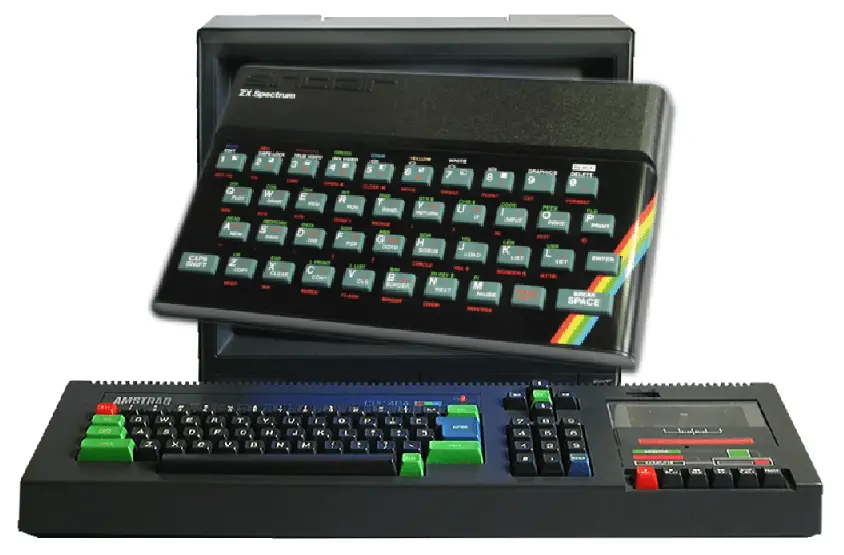
In 1980s Britain the ZX Spectrum and the Amstrad CPC were the two home computers in many playgrounds and bedrooms. The Spectrum was cheaper and had the bigger games library; the CPC had more colours, proper sound and a built-in tape deck with its own monitor. Then in 1986 Amstrad bought the Spectrum too. Here is how the two compare, in specs, games and what they’re like to own today.
Quick answer: the Spectrum has the larger library and the stronger collector scene. The CPC has better hardware for colour graphics and music, and is the more practical all-in-one machine. If you grew up with one, buy that one. If you’re starting fresh and want the most games, start with a Spectrum. If you want arcade-style colour and great AY music, try a CPC 6128 or 464.
At a glance
| Feature | ZX Spectrum 48K | Amstrad CPC 464 |
|---|---|---|
| Launched | April 1982 (Sinclair Research) | April 1984 (Amstrad) |
| CPU | Zilog Z80A, 3.5 MHz | Zilog Z80A, 4 MHz (slowed slightly in practice by video memory access) |
| RAM | 16K or 48K (128K on later models) | 64K (128K on the CPC 6128) |
| Graphics | 256 x 192, 15 colours, 2 colours per 8×8 block | 160×200 (16 colours), 320×200 (4) or 640×200 (2) from a 27-colour palette |
| Sound | 1-bit beeper (AY-3-8912 chip on 128K models) | AY-3-8912, 3 channels |
| Storage | External cassette recorder | Built-in cassette deck (3-inch disk on the 664 and 6128) |
| Display | Your TV via RF | Supplied green-screen or colour monitor |
| Launch price (UK) | £125 (16K), £175 (48K) | About £249 with green screen, £359 with colour monitor |
Graphics: attribute clash vs chunky colour
The Spectrum’s display is sharp at 256 x 192, but colour is stored per 8×8 character block, with only two colours (ink and paper) allowed in each block. When a sprite crosses into a block of a different colour, the colours “clash”. Clever developers designed around it, which is why so many Spectrum games use monochrome play areas with colourful borders and status panels. Our guide to the Spectrum colour palette and attributes explains it in detail.
The CPC has no attribute system. In Mode 0 every pixel can be any of 16 colours chosen from a 27-colour palette, at the cost of wide, chunky pixels. Mode 1 offers 4 colours at 320 x 200, which many games used, and Mode 2 offers 80-column text for business software. Well-made CPC games, especially those written for the machine rather than converted, look noticeably more colourful than their Spectrum equivalents.
Sound
The 48K Spectrum has only a 1-bit beeper driven by the CPU. Some programmers coaxed remarkable multi-channel music out of it, but most games are quiet. The CPC has a General Instrument AY-3-8912 three-channel sound chip from the start, with stereo through a headphone socket. Sinclair added the same AY chip to the Spectrum 128 (1985 in Spain, early 1986 in the UK), so 128K Spectrum games often sound far better than 48K versions.
Games: the “Speccy port” problem
The Spectrum’s bigger installed base meant publishers often wrote games for it first, then converted them to the CPC with minimal changes, since both use the Z80. These “Speccy ports” often kept the Spectrum’s limited colour and ran slower on the CPC because of its larger screen memory. That is a big reason the CPC’s reputation suffered. Games written to use the CPC’s own hardware, rather than converted from the Spectrum, show what the machine could really do. The Spectrum’s library is larger overall, and it has a very active homebrew scene that still produces new releases. See our lists of the greatest Spectrum games and underrated Spectrum games.
Build, keyboard and practicality
- Spectrum: the original 48K has the famous rubber keyboard; the Spectrum+ and 128 have harder keys. You need a cassette player and a TV, and loading can be temperamental. See why Spectrum tapes won’t load.
- CPC 464: a proper typewriter-style keyboard and a built-in tape deck, with the monitor also supplying the computer’s power. That makes it a tidy single-plug system, but a 464 bought without its monitor needs a suitable power supply (and an Amstrad MP-1 or MP-2 modulator to use a TV).
The Amstrad takeover
In April 1986 Amstrad bought the Spectrum brand and range from Sinclair. Amstrad then produced the Spectrum +2 (with a built-in tape deck, like the CPC) and the +3 (with a 3-inch disk drive, like the CPC 6128). The two lines were never merged, and the Spectrum models stayed incompatible with CPC software. The history of Sinclair computers covers the full story.
Owning one today
- Prices: working Spectrums are plentiful in the UK. See how much a ZX Spectrum is worth. CPCs, especially complete with the original colour monitor, are bulkier and less common outside the UK, France, Spain and Germany. Our Amstrad CPC buyer’s guide covers what to check.
- Display: the Spectrum’s RF output looks poor on modern TVs; a composite mod helps. See connecting a ZX Spectrum to a modern TV. The CPC’s RGB output gives a clean picture into a suitable SCART lead or upscaler, but needs the right cable and power arrangement if you’re not using the Amstrad monitor.
- Repairs: both are well documented. See how to repair a ZX Spectrum and common Spectrum faults.
- Emulation: both are easy to emulate. See the best Amstrad CPC 464 emulator. Modern hardware revivals exist for the Spectrum, including the ZX Spectrum Next and Retro Games’ The Spectrum.
Verdict
The Spectrum won on price, popularity and the size of its library, and it’s the more collectable machine. The CPC was the better-engineered package, with more colour, better sound, a real keyboard and everything in one box, and it holds up well when you play games written for it. Both are cheap enough that many retro fans end up owning one of each.
Shopping for either? ZX Spectrum on Amazon.co.uk · Amstrad CPC on Amazon.co.uk · ZX Spectrum books. For a different rivalry, read Commodore 64 vs ZX Spectrum.
As an Amazon Associate, RetroTech Lab earns from qualifying purchases. This doesn’t change the price you pay.
FAQ
Was the Amstrad CPC better than the ZX Spectrum?
In hardware terms, mostly yes: it had more colours without attribute clash, a three-channel AY sound chip, more RAM and a proper keyboard. The Spectrum was cheaper and had a much larger games library.
Are Amstrad CPC and ZX Spectrum games compatible?
No. Both use a Z80 CPU, but the graphics, sound and system software are different, so each machine needs its own version of a game.
Did Amstrad make the ZX Spectrum?
Amstrad bought the Spectrum range from Sinclair in 1986 and went on to make the Spectrum +2 and +3. The original 16K, 48K, Spectrum+ and 128 were made for Sinclair.
Which is better for a first retro computer?
The Spectrum, if you want the most games and the most community support. The CPC, if you prefer colourful arcade-style games and AY music, or want a tidy all-in-one setup with a monitor.